Reviewed · TICKETS
Beijing: Confucius Temple and the Impercial College E-ticket
Ancient exam stones make history feel personal. This Beijing ticket gives you access to two important Yuan Dynasty sites: Confucius Temple and the Imperial College, where China’s education system once trained official scholars. I like the low $7 price and the simple QR code entry, and I especially like the 51,624 names carved on stone tablets. The main drawback is that this is an admission ticket, not a guided tour, so you will need to supply your own context or buy an audio guide at the temple.
The two sites sit side by side in a traditional arrangement called temple on the left and college on the right. I also like that the ticket is valid for one day, wheelchair accessible, and usable with your original passport. A current rating of 4.4 from 92 bookings suggests a dependable visit, though the experience is best for people who enjoy museums, architecture, and quiet historical detail more than big spectacle.
In This Review
- Key points to know before you go
- Why these two Beijing sites matter
- Entering through the Confucius Temple
- The stone tablets and the imperial examination
- The Imperial College and its orderly courtyards
- What a one-day visit feels like
- The exhibitions and the audio guide option
- Is $7 good value?
- Who should book this experience?
- Practical tips for a smoother visit
- Should you book the Beijing Confucius Temple and Imperial College ticket?
- FAQ
- How much does the ticket cost?
- How long is the ticket valid?
- What must I bring for entry?
- Can I enter with a QR code?
- What does the ticket include?
- Is an audio guide included?
- Can I cancel the booking?
Key points to know before you go
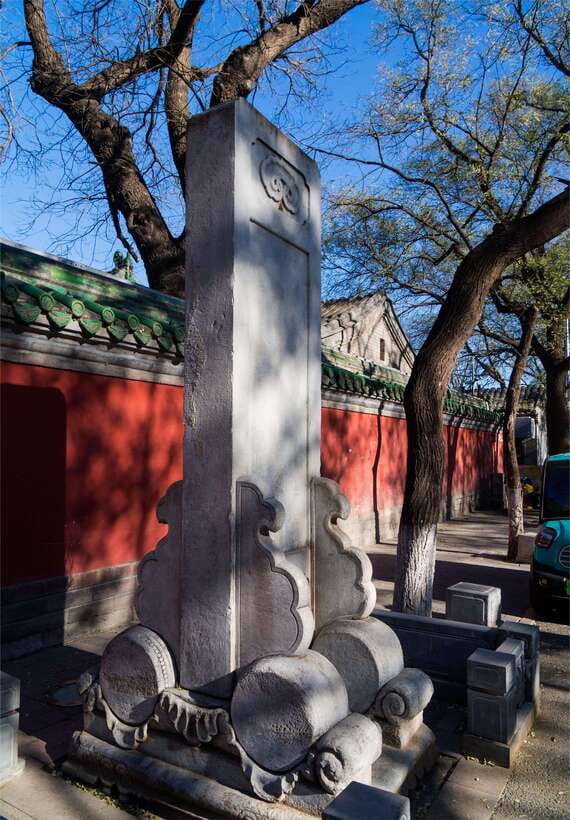
- 51,624 successful candidates appear on stone tablets, giving the imperial examination a human scale.
- The Confucius Temple dates from 1306, while the Imperial College was built in 1308 during the Yuan Dynasty.
- Two sites share one visit, arranged as temple on the left and college on the right.
- QR code entry is straightforward, but you must bring your original passport or ID card.
- An audio guide may be available at the temple entrance, useful because no live guide is described.
- The $7 admission price is strong value, especially if you take time to see the exhibitions and courtyards.
Why these two Beijing sites matter
Beijing’s Confucius Temple and Imperial College offer a different side of the capital. You will not find the grand imperial scale of the Forbidden City here. Instead, you get a focused look at education, government, ritual, and the long path toward official status in China.
The complex was built in the 14th century under the Yuan Dynasty and has more than 700 years of history. The Confucius Temple held memorial ceremonies for Confucius during the Yuan, Ming, and Qing Dynasties. Beside it, the Imperial College served as the highest state educational institution and as the government body responsible for education during those same three dynasties.
That pairing is the real strength of the visit. The temple shows how Confucian thought was honored. The college shows how that thought shaped education and public service. You can walk from religious ceremony to state learning without leaving the same historic complex.
I find this kind of site most rewarding when I take it slowly. The buildings are not difficult to understand physically, but their purpose becomes clearer as you move through the gates, halls, tablets, and exhibits. If you rush in for a few photographs, you may miss the central idea: education was not simply personal advancement. It was tied to family honor, government service, and the moral order of the state.
A few more tours worth putting side by side
- From Beijing: Mutianyu Great Wall Tours with Options
★ 4.9 · 9,216 reviews - Beijing: Forbidden City Tour(Group/Private)-Tickets Included
★ 4.8 · 7,974 reviews - Beijing: T-Square & Forbidden City Group or Private Tour
★ 4.8 · 4,446 reviews
Entering through the Confucius Temple
Your visit begins with the Confucius Temple, built in 1306. The temple covers more than 22,000 square meters, with about 7,400 square meters of building space. Its three courtyards follow a central south to north axis, creating a measured progression through the complex.
The route passes through the Teacher Gate, Dacheng Gate, Dacheng Hall, and Chong Sheng Temple. These names are more than a list of stops. The gates and halls create a sequence that gradually moves you toward the central ritual spaces.
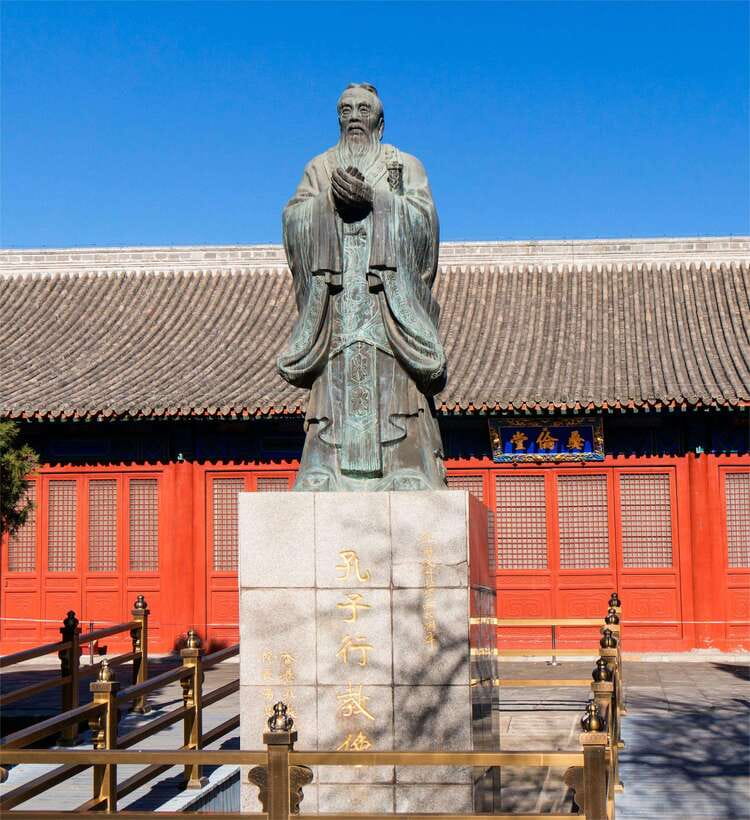
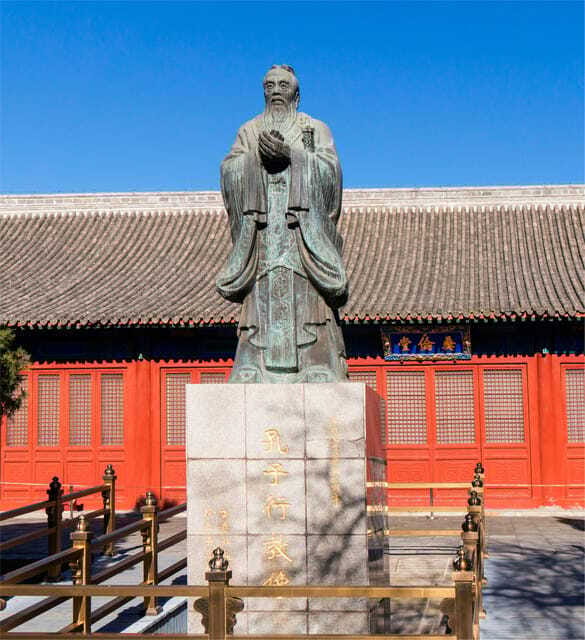
The Dacheng Hall is especially important. One of the current exhibitions presents a restored version of the hall, helping you understand how this key building functioned. Another exhibition focuses on Confucius, while a third covers the history of the Beijing Confucius Temple.
The exhibition material gives the buildings a useful frame. Without it, you might see formal halls and courtyards but not fully grasp why they were arranged in this way. Since the admission ticket does not include a guide, an audio guide available for purchase at the temple entrance may be worth considering if you want more explanation.
The temple’s size is manageable for a self-guided visit. You can pause in the courtyards, examine the stone inscriptions, and move between the exhibitions without needing to follow a fixed group schedule. The drawback is that the ticket offers flexibility rather than interpretation. You should expect to read, listen, or prepare a little before arriving.
The stone tablets and the imperial examination
The most memorable feature is the collection of 198 stone tablets arranged in four groups on both sides of the front courtyard. Carved into them are the names, birthplaces, and ranks of 51,624 successful candidates in the imperial examination.
This is where the visit becomes more than an architectural walk. Each name represents a person who passed through one of the most demanding systems of education in Chinese history. The tablets also show how official success was recorded and remembered.
The information on the tablets has value beyond ceremony. It provides material for studying the imperial examination system, including the origins and ranks of those who succeeded. You may not read every inscription, but the scale alone is striking. Thousands of names turn an abstract system into something visible.
I recommend giving these tablets more time than a quick glance. Look at how they are arranged and notice the way they frame the courtyard. Their placement makes academic achievement part of the physical setting, not just a subject in an exhibit.
This is also one reason the site suits history-minded visitors. The attraction does not depend on a single famous object or one dramatic viewpoint. Its appeal grows from details: inscriptions, gates, halls, and the connection between education and public life.
The Imperial College and its orderly courtyards
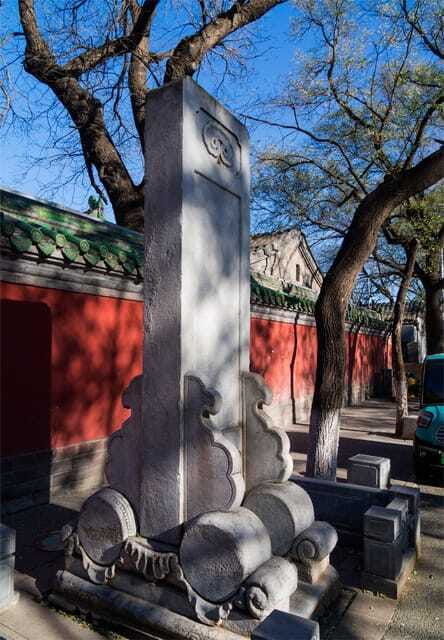
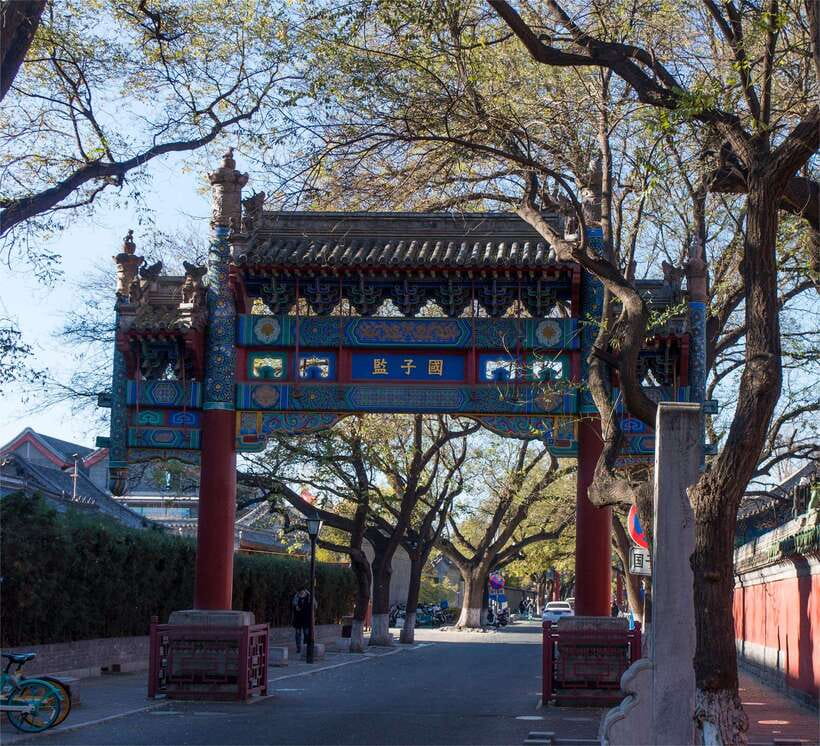
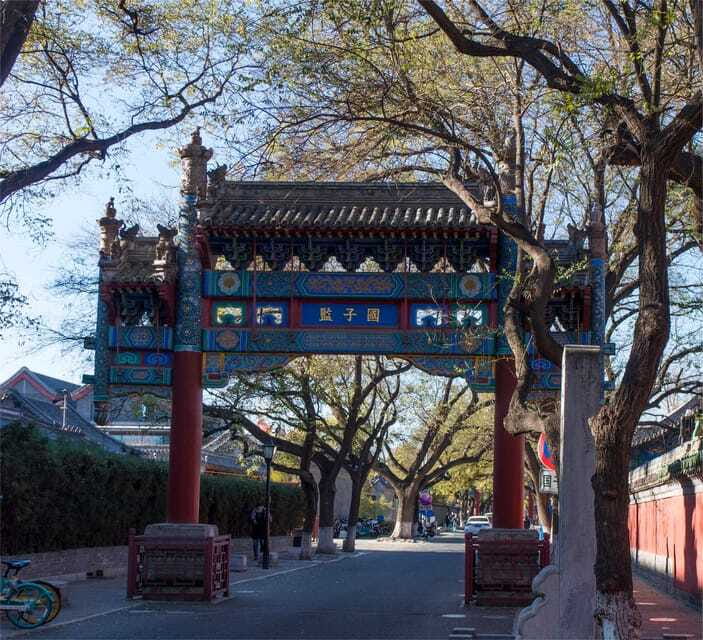
After the temple, continue into the Imperial College, known in Chinese as Guozijian. It was built in 1308, during the Yuan Dynasty, and covers about 28,000 square meters. Like the temple, it is arranged around three courtyards.
The college served as both the highest state school and the government office overseeing education during the Yuan, Ming, and Qing periods. That dual role matters. This was not only a place where students learned. It was also part of the machinery that managed learning across the state.
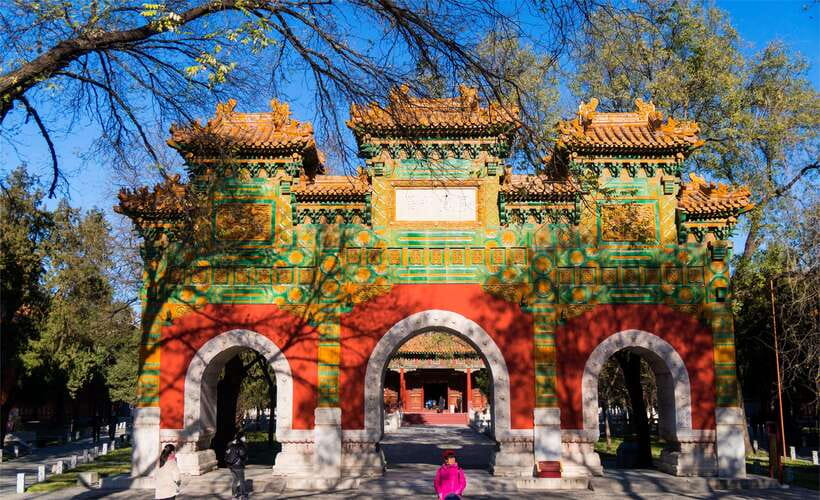
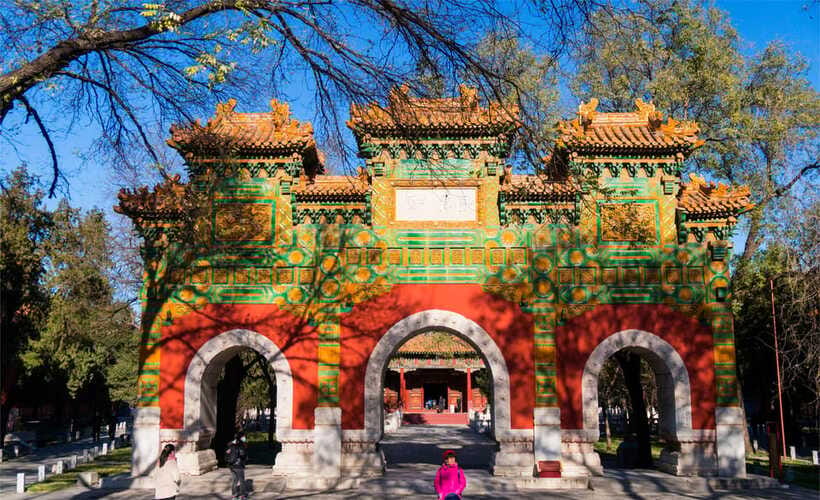
The central axis includes Jixian Gate, the Taixue or Imperial College Gate, the Glazed Memorial Arch, Biyong Hall, Yilun Hall, and Jingyi Hall. The route gives you a clear sense of formal movement from one institutional space to the next.
Biyong Hall is a major point of interest. The college also includes two halls, six main rooms, an Imperial Tablet Pavilion, and Bell and Drum Pavilions arranged traditionally and symmetrically beside the central axis. That symmetry is worth noticing. It gives the complex a calm, controlled appearance and reflects the importance placed on order in Confucian education.
The Imperial College is a good counterpoint to the temple. At the temple, ritual and remembrance take the lead. At the college, the focus shifts to teaching, administration, and the preparation of scholars for official life.
You may find the college less immediately dramatic than the temple if you are mainly looking for ornate decoration. Its value comes from the relationship between the buildings and their purpose. I would not treat it as an extra room after the main attraction. It completes the story.
A few more tours in Beijing worth putting side by side
- 4-Hour Small Group Tour to Forbidden City with Entry Tickets
★ 5.0 · 1,863 reviews - Beijing: Tiananmen Square Registration Service(Ticket)
★ 4.5 · 1,704 reviews - Beijing: The Temple of Heaven or Summer Palace Entry Ticket
★ 4.6 · 1,286 reviews - Beijing Forbidden City Ticket Booking (Optional: guide service)
★ 5.0 · 1,263 reviews
What a one-day visit feels like
The ticket is valid for one day, but no fixed starting time is given. That makes the visit easy to fit around another Beijing plan. You can check availability for the time options offered at booking, then use the ticket during its stated validity.
The visit is self-paced. There is no listed transport, meal, performance, or scheduled tour section. The included item is the attraction ticket itself, so plan on walking through the two connected historic areas at your own speed.
You can enter with your electronic ticket and original passport. The QR code is designed to make entry simple, but do not rely only on a phone image of your passport. The instructions specifically require the original passport or ID card, and that requirement matters for international visitors.
The attraction is listed as wheelchair accessible. That is helpful, though the complex includes historic courtyards and older buildings, so you may still want to allow extra time and ask on site if a particular doorway or interior route needs assistance.
Because the experience is sold as a private group option, you are not being placed into a standard guided sightseeing group according to the supplied details. Still, the ticket itself does not describe a private guide. I would think of it as private, flexible admission rather than a personal history lesson.
The exhibitions and the audio guide option
Three exhibitions are listed at the Confucius Temple. The restored Dacheng Hall exhibition focuses on the building, the Great Confucius exhibition presents Confucius as the central figure of the tradition, and the Beijing Confucius Temple history exhibition explains the site itself.
These displays are useful because the architecture can otherwise feel formal and repetitive. Exhibits give you something to look for as you move through the courtyards. They also help connect the temple to the wider educational system represented by the Imperial College.
An audio guide may be purchased at the entrance to the temple. That option is worth keeping in mind if you prefer spoken explanation or if you have not studied Confucianism before. It also solves the main weakness of the low-cost ticket: you get entry, but not a dedicated guide.
I would not assume every detail is covered by the audio guide, since the supplied information only confirms that one can be purchased. Ask about language and price at the entrance before paying. If you prefer to explore silently, the exhibits and layout still offer enough structure for a worthwhile visit.
Is $7 good value?
At $7 per person, this is one of the easier Beijing admissions to recommend on price alone. You receive entry to two historic institutions rather than a single hall or short exhibit. The ticket also avoids the need to buy separate admission for the temple and college, based on the experience description.
The value improves if you care about architecture, Chinese history, Confucian thought, or the imperial examination. The stone tablets alone provide a distinctive reason to visit, and the two sites together offer more substance than the price suggests.
The value is less clear if you want entertainment, a fully narrated tour, or a large collection of spectacular treasures. The attraction is quiet and educational. Its rewards come from understanding the setting, not from constant visual excitement.
A 4.4 rating from 92 reviews supports the idea that the ticket delivers what it promises. The short comments available are positive, including one simple excellent assessment and a note that an audio guide can be bought at the temple. Those details match the practical picture: easy entry, pleasant historical sightseeing, and optional help with interpretation.
Who should book this experience?
I would choose this ticket if you have already seen Beijing’s headline sights and want a more focused look at how education shaped Chinese government and culture. It also works well for anyone interested in Confucius, examination systems, traditional planning, or Yuan Dynasty architecture.
Families with older children may find the name tablets useful because they make the examination system easier to discuss. Students and history enthusiasts will have plenty to examine, especially in the inscriptions and exhibitions.
The visit may not suit you if you need an English-speaking guide included in the price. No guide is described, so you should be comfortable reading the displays, using an optional audio guide, or doing some preparation before you go.
It is also not the best choice for a rushed sightseeing schedule. The sites are not presented as a short timed attraction, and the value comes from seeing both institutions properly. Since the ticket lasts one day, you can choose a convenient time and avoid treating the visit like a quick photo stop.
Practical tips for a smoother visit
Bring your original passport or ID card. Your electronic ticket and QR code are useful, but they do not replace the identity document required for entry.
Allow time for both the Confucius Temple and Imperial College. The complex includes three courtyards in each section, multiple halls, gates, pavilions, exhibitions, and the tablet collection.
Consider buying the audio guide at the temple entrance if you want more background. The ticket is inexpensive partly because it does not list a live guide, so this optional extra may make the visit more rewarding.
Look beyond the largest buildings. The names, birthplaces, and ranks on the tablets are among the most distinctive details here. They give the examination system a personal and geographic dimension.
Finally, check the available starting times when you reserve. The ticket is valid for one day, but the exact entry schedule is determined by availability.
Should you book the Beijing Confucius Temple and Imperial College ticket?
Yes, if you want an affordable, self-guided visit with genuine historical substance. For $7, you gain access to a Yuan Dynasty temple, a former state college, three exhibitions, and an exceptional collection of examination tablets.
Book it with realistic expectations. This is not a guided tour and not a fast-moving attraction. Bring your passport, consider the audio guide, and give yourself enough time to connect the ceremonial temple with the educational college. If that sounds appealing, this simple ticket offers one of Beijing’s clearest lessons in how learning, ritual, and government once worked together.
FAQ
How much does the ticket cost?
The ticket costs $7 per person.
How long is the ticket valid?
The ticket is valid for one day.
What must I bring for entry?
You must bring your original passport or ID card, along with your electronic ticket.
Can I enter with a QR code?
Yes. You can use the QR code from your electronic ticket, but you must also present your original passport or ID card.
What does the ticket include?
It includes the tourist attraction ticket for Beijing Confucius Temple and the Imperial College.
Is an audio guide included?
No audio guide is listed as included. An audio guide may be available to purchase at the entrance to the Confucius Temple.
Can I cancel the booking?
Yes. You can cancel up to 24 hours in advance for a full refund. You can also reserve now and pay later, according to the booking terms.
Newest reviews from Beijing
- Jinshanling Great Wall to Simatai West Sunset Hiking Private Tour★ 5.0 · 4 reviews
- Private Tour: Mutianyu/Badaling Great Wall and Temple of Heaven★ 5.0 · 4 reviews
- Beijing: Forbidden City Guided Tour with Options★ 4.3 · 4 reviews
- Beijing: Acrobatic Show Tickets Traditional & Modern Fusion★ 5.0 · 4 reviews
- Beijing: Private Biking Tour Along Central Axis of Beijing★ 4.8 · 4 reviews
- Best Beijing Day Tour To Forbidden City and Great Wall★ 5.0 · 4 reviews
- BusDa- Private Tour: Mutianyu Great Wall &Ming Tombs(Chang Ling)★ 5.0 · 4 reviews
- Beijing: Explore the Forbidden City in Hanfu★ 5.0 · 4 reviews
Tickets, compared.
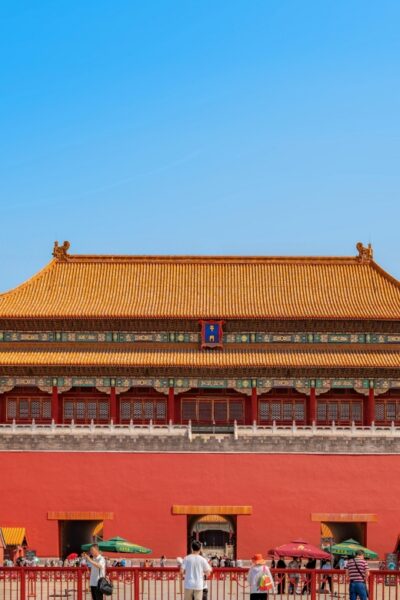
Forbidden City Tour(Group/Private)-Tickets Included
Read our review →
Mutianyu Great Wall Daily Tour with Ticket & Lunch
Read our review →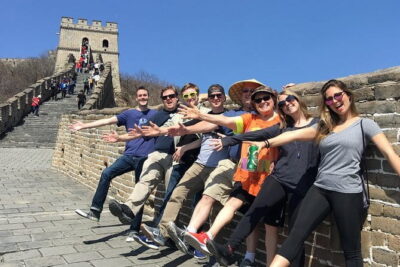
4-Hour Small Group Tour to Forbidden City with Entry Tickets
Read our review →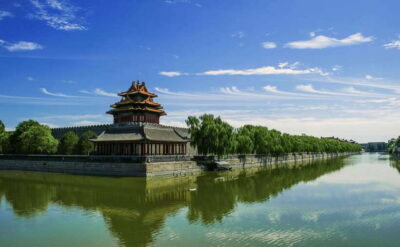

Ngong Ping 360: Cable Car Return Tickets & Combos
Read our review →
The Temple of Heaven or Summer Palace Entry Ticket
Read our review →
Beijing Forbidden City Ticket Booking (Optional: guide service)
Read our review →