
Reviewed · HISTORICAL TOURS IN BEIJING
Beijing: Bell and Drum Towers Entry Ticket—Historic Landmark
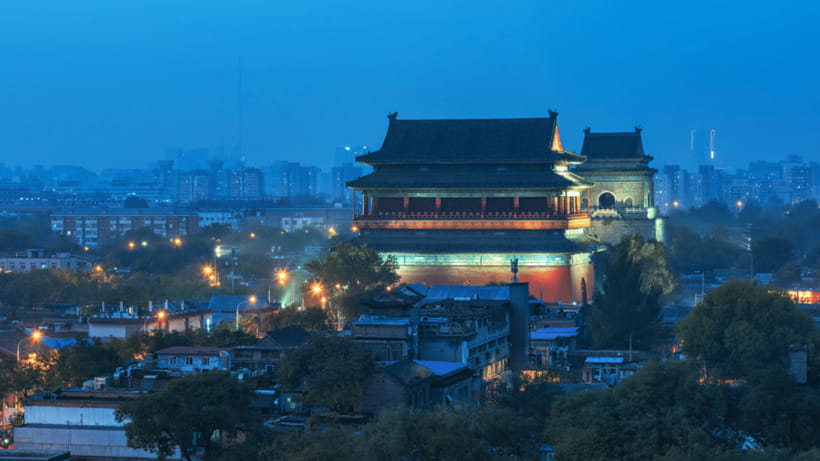
Ancient Beijing kept time with thunder. The Bell and Drum Towers give you a clear look at how imperial Beijing organized its day, with towering architecture, huge instruments, and a central location that is easy to add to a city walk. I like the chance to see the 63-ton Yongle bell and the chance to catch a live drum performance from the Drum Tower. The main drawback is that this is a self-guided visit, so you will not have a live expert explaining the details as you go.
I also like the simple ticket setup. One admission covers both towers, and an English PDF guidebook adds useful context without forcing you into a fixed group schedule. The drum performance is the big draw for many people, but its exact timing can vary, so you should check the onsite schedule rather than assume you will see it.
In This Review
- Key points at a glance
- Why Beijing’s timekeepers still matter
- Entering the Drum Tower and climbing above old Beijing
- Seeing the 63-ton bell in the Bell Tower
- What the architecture tells you
- Planning the four-hour visit
- The value of a $13 ticket
- The drum performance deserves priority
- Where the self-guided format works best
- What the ratings tell you about the experience
- Who should book this experience
- Should you book the Bell and Drum Towers ticket?
- FAQ
- How much does the Bell and Drum Towers ticket cost?
- How long does the experience last?
- Does the ticket include both towers?
- Is a guidebook included?
- Is a live tour guide included?
- Is an audio guide included?
- Can I see a drum performance?
- What is special about the bell?
- What should I bring?
- Can I cancel for a full refund?
Key points at a glance
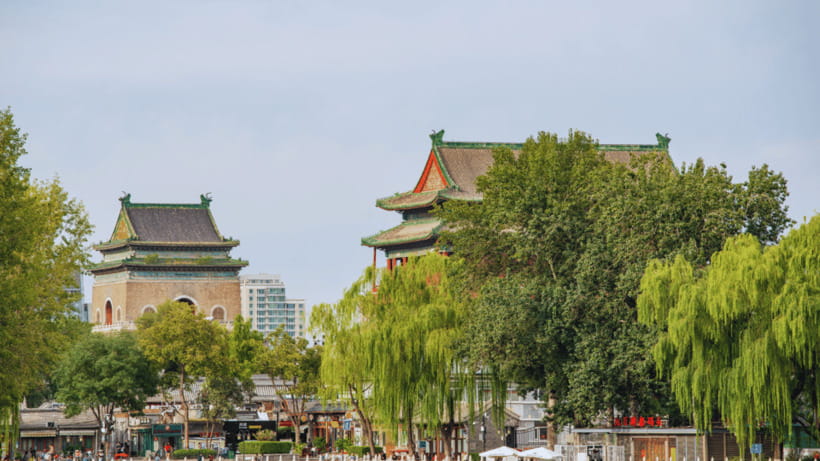
- Two towers, one historic timekeeping complex: Visit the Bell Tower and Drum Tower at the northern end of Beijing’s central axis.
- The Drum Tower performance is the highlight: A five-minute drumming display may be held during your visit, with timing set by the onsite schedule.
- A massive bell awaits upstairs: The Ming Dynasty Yongle-era bell weighs 63 tons and is known as the King of Ancient Bells.
- A good self-guided format: Your ticket includes an English PDF guidebook, but no live guide or audio guide.
- Useful four-hour window: You have plenty of time to explore at your own pace instead of rushing through the towers.
- Good value for culture lovers: At $13 per person, this is a reasonably priced way to see a major Beijing landmark.
Why Beijing’s timekeepers still matter

The Bell and Drum Towers were built originally in the Yuan Dynasty, when Beijing was taking shape as the capital of a great empire. Their job was practical: they announced the hours for the city.
The old rhythm was simple and memorable. The evening began with the dusk drum, and the morning began with the dawn bell. Before clocks and mobile phones, these sounds helped organize work, meals, official business, worship, and sleep.
That makes the towers more than photo stops. You are looking at part of the daily machinery of imperial Beijing. The buildings helped give the city a shared sense of time.
The complex sits at the northern end of Beijing’s central axis, a location that adds to its importance. Its north-south arrangement is unusual among ancient Chinese bell towers, and the architecture reflects the careful planning used in the imperial capital.
The protected site covers 12,597 square meters. You do not need to be a specialist in Chinese history to appreciate it. The scale, position, and massive instruments make the purpose of the towers easy to understand.
More Historical Tours in Beijing
- Beijing Historical Tour II including Summer Palace, Lama Temple & Panda Garden
★ 4.0 · 187 reviews - Beijing Historical Tour I – Forbidden City, Tiananmen Square & Temple of Heaven
★ 4.0 · 120 reviews - Beijing Historic City Guided Walking Tour + Calligraphy Creation
★ 5.0 · 59 reviews
Entering the Drum Tower and climbing above old Beijing
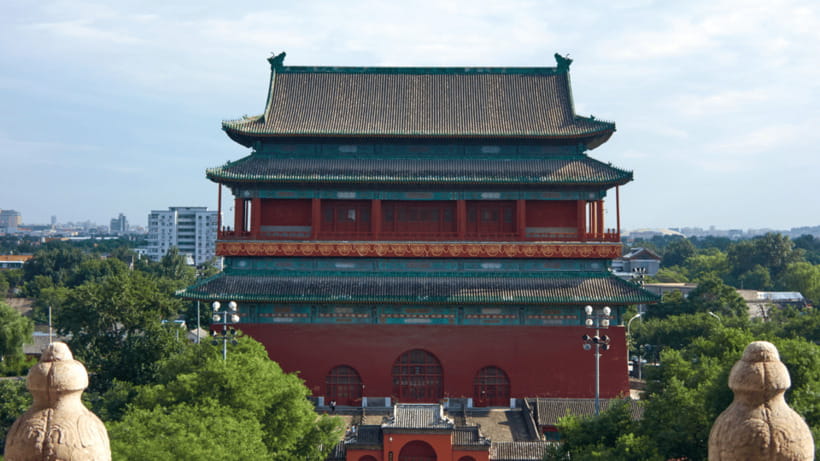
Begin with the Drum Tower if you want the most active part of the visit first. The tower once held 25 drums, and climbing to the top gives you a closer look at the instruments and the building’s upper level.
The climb is part of the experience. The towers were designed as working structures, not as quiet museum halls, and reaching the upper areas helps you understand how the drums and bells could carry sound across the old city.
The largest reward is the possible five-minute drum performance. Several high ratings for this experience focus on the drumming, and that makes sense. A live rhythm inside an old timber structure offers something a display case cannot.
The performance schedule can change, so plan with some flexibility. If you arrive at a quiet moment, explore the tower and check when the next display is due. You may need to wait, but the four-hour duration gives you room to do so.
Do not treat the performance as guaranteed at a particular minute. The available information says you may witness it, with exact timing depending on the onsite schedule. That small uncertainty is the main planning issue at the Drum Tower.
The upper levels also offer photo opportunities, though you should focus on the structure and instruments rather than expecting a formal city observation deck. The attraction is the tower itself, its height, and its role in the city’s old sound system.
Seeing the 63-ton bell in the Bell Tower
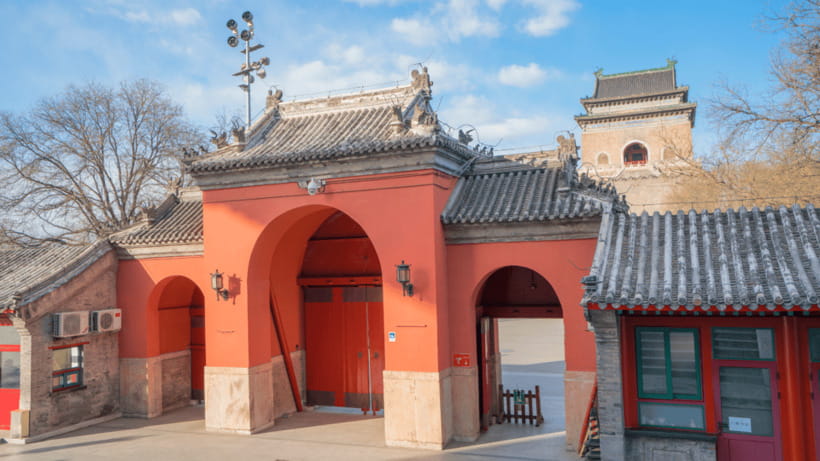
The Bell Tower offers a quieter counterpoint. Its star object is the Ming Dynasty bell made during the Yongle era.
At 63 tons, it is described as the King of Ancient Bells. That weight gives the bell an immediate sense of power, even before you consider its purpose. This was not a small household object. It was a public instrument built to carry an official signal across Beijing.
The bell also helps explain why the two towers worked as a pair. The Drum Tower marked the evening, while the Bell Tower marked the morning. One building used rhythm and force, the other used a deep ringing sound.
Take time to examine the bell rather than rushing through for a photograph. The craftsmanship reflects the resources and authority of the imperial court. You are seeing a practical object that was also a major work of metalwork.
The Bell Tower is likely to feel more contemplative than the Drum Tower. If the drum display gives your visit its theatrical moment, the giant bell supplies its strongest historical object.
What the architecture tells you

The towers are protected examples of Beijing architecture, but their value is not only visual. Their placement shows how the old city used buildings to control movement, ceremony, and time.
The north-south layout is one of the details worth keeping in mind as you walk between the towers. These were not two unrelated monuments placed near each other by chance. Together, they formed a time-telling complex at an important point in the capital.
Look at the proportions and upper structures as well as the instruments. The towers were built to project sound, house heavy equipment, and signal authority. Their design had a job to do.
The scale of the site also helps. With 12,597 square meters of protected architecture, you are not simply entering a single room with an old bell. You are exploring a larger historic compound where the buildings, instruments, and position in Beijing all work together.
The PDF guidebook can help you connect these details. Since there is no live guide included, read the guide before or during your visit if you want more than visual impressions. It should be especially useful for understanding the Yuan Dynasty origins and the later Ming Dynasty bell.
A completely different kind of day out on the same trip:
- From Beijing: Mutianyu Great Wall Tours with Options
★ 4.9 · 9,216 reviews - Beijing: Forbidden City Tour(Group/Private)-Tickets Included
★ 4.8 · 7,974 reviews - Beijing: T-Square & Forbidden City Group or Private Tour
★ 4.8 · 4,446 reviews - All-Inclusive Tour: Tiananmen Square, Forbidden City, Great Wall
★ 5.0 · 2,873 reviews
Planning the four-hour visit

The stated duration is four hours, but that does not mean you must spend every minute inside the towers. It gives you a relaxed window to visit both buildings, pause for photographs, read the guidebook, and wait for the drum performance if the timing is close.
A sensible plan is:
- Start at the Drum Tower and check the performance schedule.
- Climb to the upper level and inspect the drums.
- Watch the five-minute performance if the timing works.
- Continue to the Bell Tower and spend time with the Yongle-era bell.
- Use the English PDF guidebook to review the history at your own pace.
The ticket includes entry to both the Bell Tower and Drum Tower. It also includes skip-the-ticket-line access, which can save time at a busy central attraction.
You still need to bring your passport or ID card. Keep it handy rather than buried at the bottom of your bag.
No transportation is included in the activity details, so you should plan your route to the site separately. The central Beijing location makes the towers practical to pair with other sightseeing, but the exact route and travel time depend on where you begin.
The format is flexible. You are not tied to a group leader or a fixed spoken tour. That is useful if you like to stop for photos or read at your own speed. It is less useful if you want every architectural feature explained in person.
The value of a $13 ticket

At $13 per person, this is a fair price for access to two major historic structures, especially if you care about Chinese history, traditional architecture, or photography.
The value comes from the combination rather than from one isolated exhibit. You get the Drum Tower, its 25-drum tradition, the possible live performance, the Bell Tower, and the enormous Yongle bell under one admission.
The English PDF guidebook adds a little more value for international visitors. It gives you background without requiring an additional guide fee. You should not expect the same depth as a private historian-led tour, but it can make a self-guided visit much more satisfying.
The lack of a live guide keeps the cost down. It also means you need to take more responsibility for the experience. If you want dates, architectural explanations, and cultural context delivered in a clear sequence, you may find the format spare.
For many people, the low price is a strength. You can visit the towers as part of a larger Beijing day without committing a large part of your sightseeing budget. The attraction also has enough substance to reward more than a quick photograph.
The drum performance deserves priority

The strongest feature for many visitors is the drumming display. One five-star rating calls the performance unforgettable, and another says the demonstration is the reason to go. That praise points to the part of the experience with the most emotional impact.
Ancient instruments can feel distant when they sit silently behind barriers. A live performance changes that. The sound gives you a better idea of how the Drum Tower might once have functioned as a public time signal.
The display lasts about five minutes, so it does not take over your entire visit. That is a good balance. You get a short, focused performance and still have time to explore the buildings.
Keep your expectations realistic. The performance schedule may vary, and the available information does not give one fixed daily time. Check when you arrive and leave room in your plan.
If you are especially interested in the drum display, make it your first priority. If you miss it, the towers remain worthwhile for their architecture and historic instruments, but the visit will feel quieter and less distinctive.
Where the self-guided format works best
I would recommend this experience to people who like to set their own pace. You can move between the towers, stop for photographs, and use the PDF guidebook when a detail catches your attention.
The format also suits visitors who have already seen Beijing’s major palace and temple sites and want a different view of the old capital. The towers focus on an everyday need, telling time, rather than on royal residences or religious ritual alone.
Families and older children may enjoy the large drums and bell more than a text-heavy museum. History enthusiasts will appreciate the Yuan Dynasty origins, the Ming Dynasty bell, and the connection between sound and public life.
The visit may be less satisfying if you need constant explanation. There is no live tour guide and no audio guide included. Communication can also be difficult for some international visitors, as one five-star review specifically points out.
That does not make the attraction unfriendly. It simply means you should arrive prepared with the PDF guidebook and a clear idea of what you want to see.
What the ratings tell you about the experience
The overall rating is 4.6 from 23 reviews, with the highest praise aimed at the service and the drum performance.
One visitor from the United States found the tickets easy to use and appreciated clear communication through WhatsApp. That suggests the booking process is straightforward, which matters when you are navigating a large city and want to avoid confusion at the entrance.
Several other high ratings praise the service. The activity provider is Panda Happy Journey in China, and the available feedback gives the impression of a well-organized ticket product rather than a guided cultural tour.
A Spanish visitor offered a more restrained view, describing the towers as worthwhile mainly if you have already done much of what Beijing offers and want to learn how time was told in the old city. I think that is a fair way to judge the attraction.
The Bell and Drum Towers are not an all-day destination by themselves for most people. Their appeal depends on your interests. If old architecture and traditional instruments excite you, they can be a memorable stop. If you want a long guided program with many rooms and formal storytelling, you may find the visit brief.
Who should book this experience
I would choose this ticket if you want:
- A reasonably priced historic stop in central Beijing
- A chance to see a large ancient bell and traditional drums
- The possibility of a five-minute live drumming display
- A flexible visit without a group or fixed guided route
- An English guidebook to support independent exploration
- A cultural attraction that fits into a larger sightseeing day
I would think twice if you require a live guide, a guaranteed performance time, or detailed spoken commentary throughout the visit. The ticket is designed for independent exploration, and that is both its main benefit and its main limitation.
The experience also works best when you care about context. Without knowing that the towers once marked dusk and morning, you might see only two old buildings. With that context, you can picture the sound of the imperial city beginning and ending its day.
Should you book the Bell and Drum Towers ticket?
Yes, if you want a compact and affordable look at Beijing’s old civic life. At $13, entry to both towers plus an English PDF guidebook is good value, especially if you arrange your visit around the possible drum performance.
I would not book it as your only major Beijing sightseeing experience. Instead, use it as a focused stop for architecture, instruments, and the city’s old timekeeping system.
Go early enough to check the drum schedule, bring your passport or ID card, and keep your four-hour window flexible. If the drums are performing, you may get the visit’s most memorable moment. If not, the 63-ton bell and the towers’ unusual north-south design still make this a worthwhile cultural stop.
FAQ
How much does the Bell and Drum Towers ticket cost?
The ticket costs $13 per person.
How long does the experience last?
The stated duration is four hours.
Does the ticket include both towers?
Yes. It includes entry to the Bell Tower and the Drum Tower.
Is a guidebook included?
Yes. An English PDF guidebook for the Bell and Drum Towers is included.
Is a live tour guide included?
No. A live tour guide is not included.
Is an audio guide included?
No. An audio guide is not included.
Can I see a drum performance?
You may see a five-minute drum performance at the Drum Tower. The exact time can vary according to the onsite schedule.
What is special about the bell?
The Ming Dynasty Yongle-era bell weighs 63 tons and is known as the King of Ancient Bells.
What should I bring?
You should bring your passport or ID card.
Can I cancel for a full refund?
Yes. You can cancel up to 24 hours in advance for a full refund.
Newest reviews from Beijing
- Beijing: Explore the Forbidden City in Hanfu★ 5.0 · 4 reviews
- Beijing Tai Chi and Tea Ceremony Experience★ 5.0 · 4 reviews
- Jinshangling Great Wall Of Beijing Tickets And Other Option★ 4.0 · 4 reviews
- Private Full-Day Great Wall of China Hiking Tour from Jiankou to Mutianyu★ 4.5 · 4 reviews
- Tour the Great Wall with a Native from Downtown Beijing★ 4.8 · 4 reviews
- Beijing: Badaling Great Wall Private Tour w Language Option★ 4.3 · 4 reviews
- Beijing:Summer Palace & Tea or Calligraphy Experience Tour★ 4.6 · 4 reviews
- 7 Days Private Tour of Beijing, Xian, Shanghai by Bullet Train★ 5.0 · 4 reviews
Historical Tours in Beijing, compared.

Beijing Historical Tour II including Summer Palace, Lama Temple & Panda Garden
Read our review →
Beijing Historical Tour I – Forbidden City, Tiananmen Square & Temple of Heaven
Read our review →
Beijing Historic City Guided Walking Tour + Calligraphy Creation
Read our review →
Beijing Culture: Tea Ceremony, Heritage Instrument & Calligraphy
Read our review →
2-Hour Beijing Private Forbidden City Tour: History & Highlights
Read our review →
Tiananmen Square Entry Reservation – Iconic Landmark
Read our review →
Forbidden City&Hutong Private Tour w/Historic Site Add-ons
Read our review →
Beijing Hutong Walking Tour History, Architecture and Local Life
Read our review →Browse the lists this tour appears in