
Reviewed · CALLIGRAPHY CLASSES
Beijing Culture: Tea Ceremony, Heritage Instrument & Calligraphy
Culture feels different when your hands are involved. This 2.5-hour Beijing workshop moves beyond watching a performance: you brew and taste Chinese tea, write traditional characters, and play a short melody on the Guqin, China’s ancient seven-string instrument. I especially like the small group of no more than eight people and the chance to learn from practicing cultural masters rather than actors. The main drawback is location: transportation is not included, so you must make your own way to 813 Creative Park in Chaoyang.
The setting is a private, air-conditioned heritage venue away from Beijing’s major sightseeing crowds. I also like that the session is conducted in English by a bilingual guide with an M.A. in History and Sociology, making the traditions easier to understand instead of turning them into a silent photo opportunity. At $78.60 per person, it is not a budget activity, but the price is reasonable if you value personal instruction, a small group, and hands-on time with three important Chinese art forms.
In This Review
- What makes this Beijing workshop special
- A quiet beginning at 813 Creative Park
- The tea ceremony: more than a cup of tea
- Meeting the Guqin, China’s ancient seven-string instrument
- Chinese calligraphy with a personal result
- Why the small group matters
- The guide and the teaching style
- Is $78.60 a fair price?
- Who should book this experience?
- Practical advice before you go
- Should you book this Beijing culture experience?
- FAQ
- How long does the experience last?
- Where does the experience begin?
- Where does the activity end?
- Is transportation included?
- How many people can join the activity?
- What is included in the price?
- Can I cancel for a refund?
What makes this Beijing workshop special
- You play the Guqin yourself, with direct guidance from a national-level heritage artist.
- The tea ceremony is hands-on, so you brew and taste the tea instead of only watching a demonstration.
- Your calligraphy has personal meaning, including help writing a Chinese name or meaningful characters.
- The group is capped at eight, which allows for individual guidance and a quieter room.
- Traditional clothing is available, giving you a chance to take ritual-style photographs.
- The venue is closed to the general public, creating a calm break from Beijing’s crowded attractions.
A quiet beginning at 813 Creative Park
The experience begins at 813 Creative Park, listed at VGP3+CCX in Chaoyang, Beijing. The meeting point is important because this is not a hotel pickup tour. You need to arrange your own transportation, and the activity ends at the same location.
That setup has both good and bad sides. The good part is that the venue feels removed from the usual sightseeing circuit. You are not being rushed from one famous monument to another, and you do not have to share the session with a large bus group. The less convenient part is that you need to plan your arrival carefully, particularly if you are still learning your way around Beijing.
The space itself is described as serene, air-conditioned, and decorated for traditional arts. You can expect a private room designed for conversation, practice, and ceremony rather than a theater packed with spectators. That makes a real difference. Tea, calligraphy, and Guqin music all benefit from a slow pace, and the room seems designed to protect that mood.
The activity is listed as suitable for most people, with service animals allowed and public transportation nearby. Confirmation arrives within 48 hours of booking, subject to availability. Since the group has a maximum of eight people, it is wise to book ahead, especially if you have a fixed Beijing schedule.
More Calligraphy Classes in Beijing
- Beijing Calligraphy Class
★ 4.9 · 112 reviews - Chinese Calligraphy Class for Small Group
★ 5.0 · 104 reviews - Beijing Historic City Guided Walking Tour + Calligraphy Creation
★ 5.0 · 59 reviews
The tea ceremony: more than a cup of tea
The tea portion opens the workshop with a useful lesson in patience. A certified tea master guides the brewing and tasting, explaining the purpose behind the movements and the role tea has played in Chinese social and philosophical life.
You are not simply handed a cup. You take part in the process, then taste the tea you have prepared. That small act changes the experience. The ceremony becomes something you perform and feel, not just something you photograph.
Tea snacks are included, but this is not a meal. Plan to eat beforehand or afterward if you need lunch or dinner. The provided refreshments are meant to support the ceremony, not replace a full meal.
I would give this section your full attention even if you are not a tea enthusiast. The pace offers a welcome pause after the noise and scale of Beijing sightseeing. Warm tea, careful movements, and quiet conversation can reset your day in a way that another crowded attraction may not.
The ceremony may also be the easiest part for beginners. You do not need prior knowledge of Chinese tea customs, and the guide explains the meaning of the ritual in English. If you are unfamiliar with the etiquette, you can simply follow along. The tone is educational rather than intimidating.
Meeting the Guqin, China’s ancient seven-string instrument
The Guqin session is the most unusual part of the experience. The Guqin is a classical Chinese zither with seven strings, traditionally linked with scholars, meditation, and refined study. It is not a loud, showy instrument. Its tones are soft and measured, which suits the quiet venue.
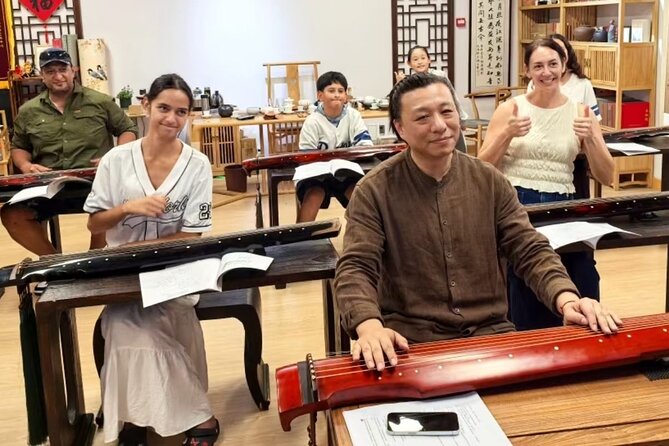
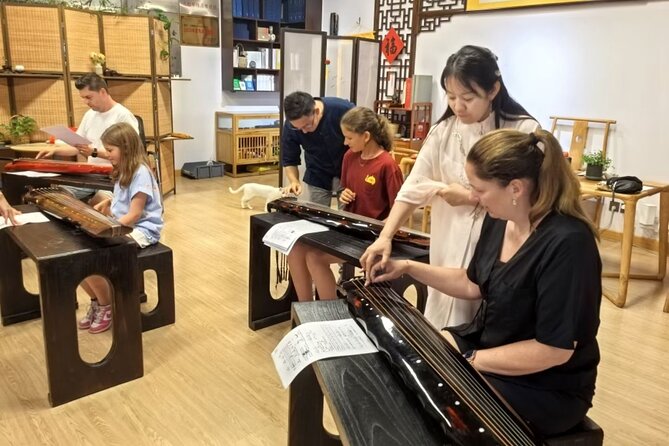
First, a national-level heritage artist performs for the group. This gives you a chance to hear the instrument properly before trying it yourself. Then comes the practical lesson, where you learn to play a full melody with the artist guiding your fingers.
That phrase, a full melody, matters. You are not only plucking one string for a souvenir photograph. The workshop aims to give you a basic musical result, even if your playing is far from polished. The point is not to become a Guqin musician in one afternoon. The point is to understand the instrument through your own hands.
The lesson can be surprisingly personal. Directly placing your fingers on the strings makes the instrument feel less like a protected museum object and more like a living tradition. You may find the first sounds uneven. That is part of the fun, and the small group means the instructor can offer individual help.
The Guqin portion may be especially appealing if you have already visited museums in Beijing and want something more active. Museums explain what an object is. Here, you get a short encounter with how it feels to use one.
There is also an emotional quality to the music. The performance and the tea ceremony work well together because both rely on restraint. Nothing is pushed at you. You are given time to listen.
Chinese calligraphy with a personal result
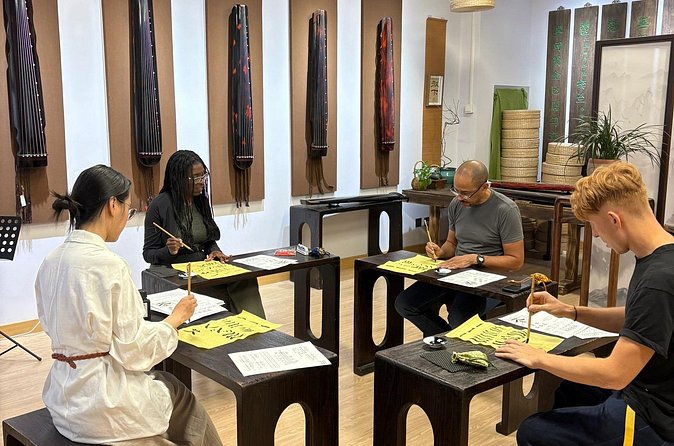
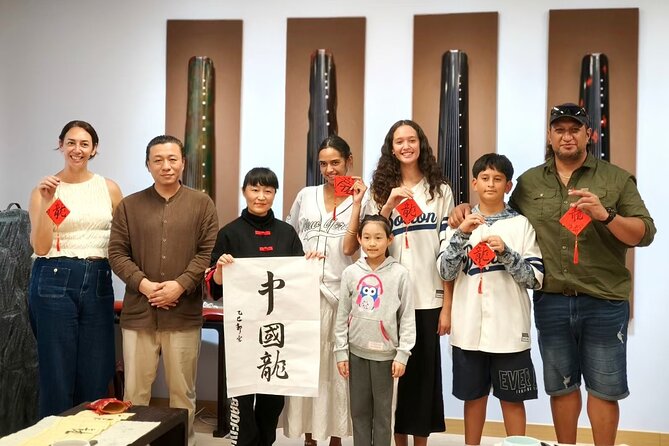
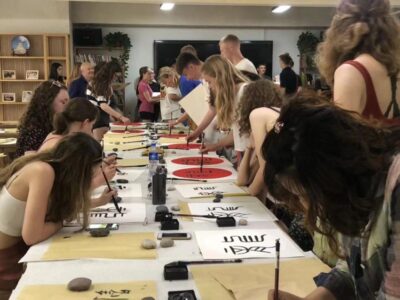
The calligraphy workshop provides the most tangible souvenir. An expert guides you in writing traditional Chinese characters with a brush, while also explaining their ancient roots and meaning.
For many people, the best choice is a Chinese name or a character connected to an idea such as peace, courage, family, or good fortune. The supplied experience specifically highlights help writing a Chinese name, and you can take the finished paper home. It is a much more meaningful keepsake than a generic shop purchase.
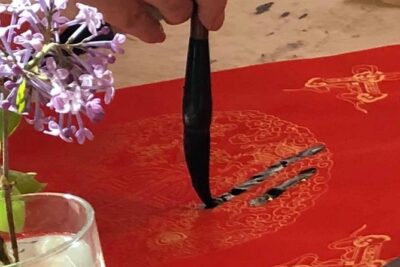
Calligraphy looks simple until you hold the brush. The pressure, angle, and order of each stroke matter. Your first attempt may wobble, but the teacher’s guidance helps you understand why the characters are formed in a certain way.
This section is practical for families, couples, and first-time visitors to China because it creates an object you can keep. The workshop is not only about looking graceful in a photograph. You are learning the basic discipline behind the writing.
The calligraphy class also adds balance to the Guqin lesson. The instrument asks you to listen and coordinate your fingers. The brush asks you to slow down and control your hand. Both reward concentration, but in different ways.
Traditional clothing is available for the ritual and photographs. This can make the session feel more ceremonial, though you should see it as an optional part of the atmosphere rather than the main reason to book. The strongest value comes from the instruction and contact with the arts.
More Historical Tours in Beijing
- Beijing Historical Tour II including Summer Palace, Lama Temple & Panda Garden
★ 4.0 · 187 reviews - Beijing Historical Tour I – Forbidden City, Tiananmen Square & Temple of Heaven
★ 4.0 · 120 reviews - 2-Hour Beijing Private Forbidden City Tour: History & Highlights
★ 5.0 · 28 reviews - Beijing: Bell and Drum Towers Entry Ticket—Historic Landmark
★ 4.6 · 23 reviews
Why the small group matters
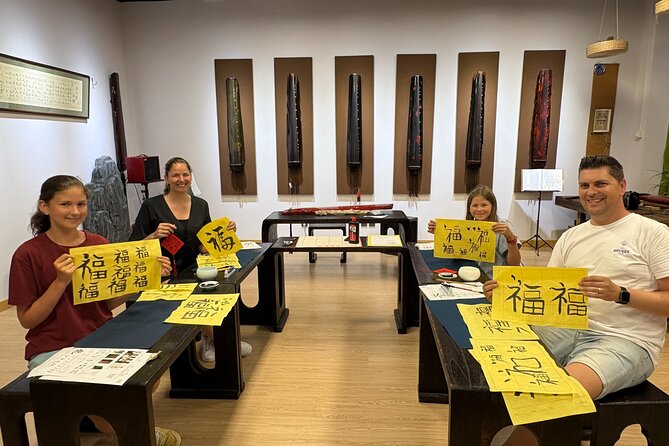
A maximum of eight people is one of the clearest strengths here. Tea ceremony, music instruction, and brushwork are difficult to enjoy in a large crowd. You want to see the teacher’s hands, hear the explanations, and get a turn with the Guqin.
A small group also makes it easier to ask basic questions without feeling self-conscious. You can say that you know nothing about tea or Chinese characters and still take part comfortably. The experience is designed to make the traditions approachable.
The size creates a quieter social setting, too. You may share the session with people who have very different levels of interest, but the format leaves room for each person to engage at their own pace. Someone may focus on the philosophy of tea, while another person cares most about calligraphy photographs. Both approaches fit.
The setting is described as private and closed to the public. That does not mean you should expect total silence, but it does mean the session is protected from the noise and interruptions common at major Beijing sights.
The guide and the teaching style
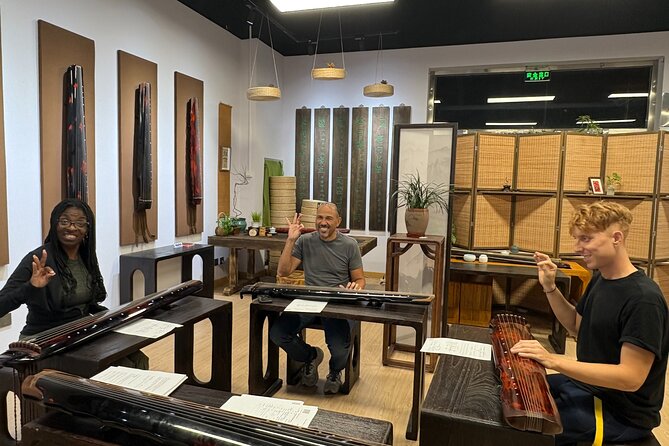
The bilingual guide has an M.A. in History and Sociology and explains the connections between the activities, Chinese philosophy, and cultural history. That background is useful because the three sections could otherwise feel like unrelated demonstrations.
Good interpretation is especially important for the tea ceremony. Without context, the movements can seem formal for formality’s sake. With explanation, you begin to see the ceremony as a way of expressing attention, respect, and balance.
The same applies to calligraphy. You are not only copying shapes. You are learning that the character has an origin and structure. Even a simple lesson can help you notice Chinese writing differently during the rest of your trip.
The Guqin artist brings specialist skill, while the guide helps translate the wider meaning for an English-speaking audience. That combination gives the session more substance than a standard cultural show.
One caution: the activity is described in glowing terms, but individual teaching styles can vary. If you prefer a fast-moving tour with constant sightseeing, this workshop may feel slow. That slower rhythm is central to its appeal, but it will not suit every schedule or personality.
Is $78.60 a fair price?
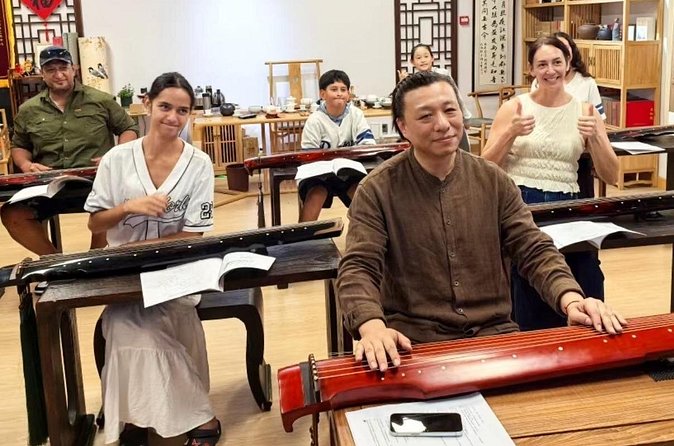
At $78.60 per person, this workshop costs more than a basic tea tasting or a short calligraphy class. You are paying for three activities, a small group, specialist instruction, a bilingual guide, tea snacks, traditional clothing rental, and a live Guqin performance.
The value is strongest if you would otherwise pay for several separate cultural activities. You get a tea ceremony, a music lesson, a calligraphy session, and a performance in one 2.5-hour visit. The small group also gives you more personal contact than a large public demonstration.
The price is less attractive if you mainly want a polished show or a quick introduction. This is a participation-based experience, and the benefit depends on your willingness to slow down and try each activity.
I would compare it to the cost of a quality workshop rather than the cost of a sightseeing ticket. You are buying time with teachers and access to a private setting. For a first visit to Beijing, it can add depth to an itinerary dominated by palaces, temples, walls, and large public squares.
Who should book this experience?
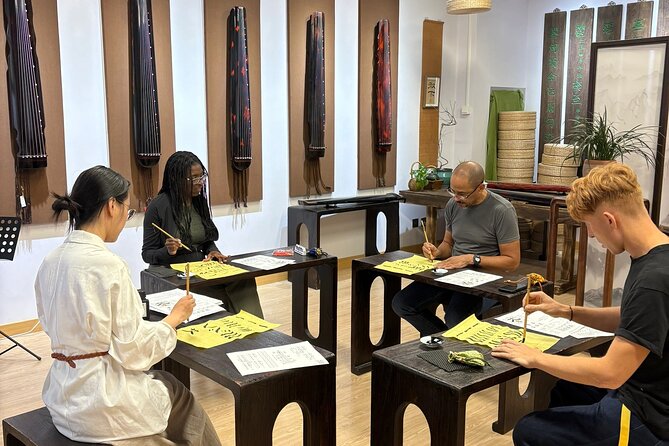
I would recommend it to you if you want to understand Chinese culture through action. It suits couples, families with older children, solo visitors, and anyone who prefers small-group activities to staged entertainment.
It is also a good choice for repeat visitors and people who have lived in China but still want a quiet introduction to traditional arts. The setting and subject matter offer something different from the standard Beijing checklist.
You should also consider it if you are studying Chinese culture, East Asian history, music, or calligraphy. The academic background of the guide and the presence of national-level artists give the session more weight than a purely decorative cultural activity.
You may want to skip it if your schedule is extremely tight, your main goal is food, or you dislike guided workshops. The activity takes 2.5 hours, plus the time required to reach Chaoyang and return to your next stop. It is not a quick stop between the Forbidden City and another major sight.
Practical advice before you go
Set aside enough time to reach 813 Creative Park. Transportation is not included, and the activity begins and ends at the meeting point. Since the exact public transportation details are not provided, check your route before leaving and allow time to find the venue.
Wear something comfortable for sitting, writing, and playing the instrument. Traditional clothing is available for the ritual and photographs, so you do not need to dress in costume yourself.
Eat before or after if you need a full meal. Tea snacks are included, but no other meal is provided.
The activity is mobile-ticket based, and confirmation is sent within 48 hours, subject to availability. Free cancellation is available if you cancel at least 24 hours before the start time. Last-minute changes are not accepted, and a full refund or alternate date is offered if the experience is canceled because of poor weather or insufficient participation.
Should you book this Beijing culture experience?
Book it if you want a calm, personal encounter with Chinese traditions and you are willing to participate rather than sit back. The Guqin lesson is the rarest feature, while the calligraphy gives you a useful keepsake and the tea ceremony provides the quiet center of the session.
I would not book it solely for costume photographs or a quick cultural performance. The real value is the patient instruction, the small group, and the chance to touch practices you normally see behind glass.
For $78.60, it is a worthwhile splurge for a culture-focused itinerary. If Beijing’s major sights leave you wanting a more human connection with China, this workshop offers a thoughtful change of pace.
FAQ
How long does the experience last?
The activity lasts approximately 2 hours and 30 minutes.
Where does the experience begin?
It begins at 813 Creative Park, VGP3+CCX, Chaoyang, Beijing, China, 100124.
Where does the activity end?
The experience ends back at the meeting point.
Is transportation included?
No. Transportation to and from the venue is not included.
How many people can join the activity?
The group has a maximum of eight participants.
What is included in the price?
The price includes a traditional tea ceremony and tasting with a certified tea master, a live Guqin performance, a hands-on Guqin lesson, a Chinese calligraphy workshop, traditional outfit rental, and a bilingual guide.
Can I cancel for a refund?
Yes. You can receive a full refund if you cancel at least 24 hours before the experience start time. Changes or cancellations made less than 24 hours in advance are not accepted for a refund.
More Tea Tastings in Beijing
- Traditional Chinese Tea Ceremony Experience
★ 4.7 · 74 reviews - Chinese Tea ceremony in Beijing Hutong courtyard
★ 4.7 · 26 reviews - Private Beijing Markets Tour with Tea Tasting at Hongqiao Pearl Market
★ 5.0 · 18 reviews - Beijing: Mutianyu Great Wall and Tea House Private Tour
★ 5.0 · 11 reviews
Newest reviews from Beijing
- Beijing: Explore the Forbidden City in Hanfu★ 5.0 · 4 reviews
- Beijing Tai Chi and Tea Ceremony Experience★ 5.0 · 4 reviews
- Jinshangling Great Wall Of Beijing Tickets And Other Option★ 4.0 · 4 reviews
- Private Full-Day Great Wall of China Hiking Tour from Jiankou to Mutianyu★ 4.5 · 4 reviews
- Tour the Great Wall with a Native from Downtown Beijing★ 4.8 · 4 reviews
- Beijing: Badaling Great Wall Private Tour w Language Option★ 4.3 · 4 reviews
- Beijing:Summer Palace & Tea or Calligraphy Experience Tour★ 4.6 · 4 reviews
- 7 Days Private Tour of Beijing, Xian, Shanghai by Bullet Train★ 5.0 · 4 reviews
Calligraphy Classes, compared.
Beijing Historic City Guided Walking Tour + Calligraphy Creation
Read our review →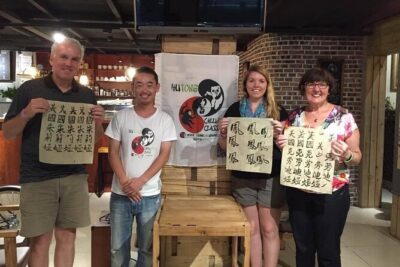
Beijing Wangfujing Calligraphy Class by Forbidden City
Read our review →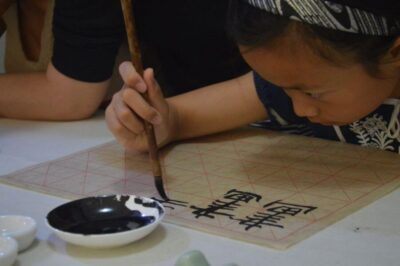
Beijing Wangfujing Calligraphy Class Nearby Forbidden City
Read our review →
2-Hour Chinese Calligraphy with an Artist in Shanghai, China
Read our review →
Discover Old Beijing: Hutong Walking Tour & Calligraphy
Read our review →Browse the lists this tour appears in