
Reviewed · HUTONG TOURS
Discover Old Beijing: Hutong Walking Tour & Calligraphy
Old Beijing still hides in plain sight. This 3.5-hour walking tour connects famous central sights with narrow hutongs, a working courtyard, street snacks, and a calligraphy activity. I like the mix of major landmarks and everyday neighborhood life, and I especially like that you make a piece of Chinese artwork to take home.
The English-speaking guides are the heart of the experience. Carrie has explained how hutongs have changed over time, while Shery has earned praise for her friendly, clear style. One caution: a recent booking described the tour as tip-based and felt the $25 platform price was high for that arrangement, so confirm exactly how payment works before you go.
In This Review
- Key points to know
- Why this Beijing walking tour works
- Meeting at Hufangqiao and Huguang Guild Theatre
- Beijing hutongs and the special courtyard visit
- Yangmeizhu Byway and Beijing’s old commercial life
- Calligraphy at the local studio
- Daguanlou Cinema and the birthplace of Chinese cinema
- Dashilan Residential District and snack break
- Qianmen Street and Zhengyang Gate
- The outside view of Tiananmen Square
- What the guides add to the walk
- Walking demands, timing, and preparation
- Who should book this experience?
- Should you book the Old Beijing hutong walk?
- FAQ
- How long does the Beijing hutong walking tour last?
- What language is the tour conducted in?
- Where is the meeting point?
- How will I find the tour group?
- Should I arrive early?
- Is a calligraphy activity included?
- Are snacks included?
- Does the tour visit Tiananmen Square?
- Can I cancel the booking?
Key points to know
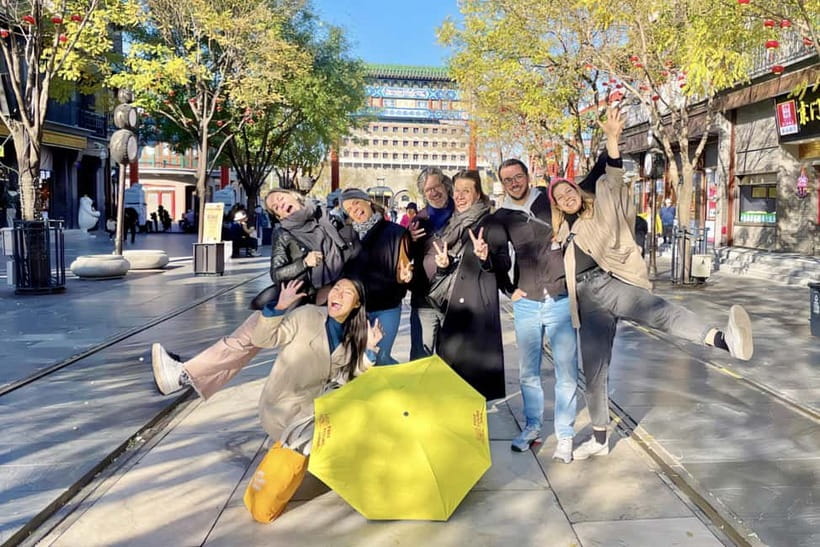
- Start at Hufangqiao Metro Station: Meet by Exit D and look for the yellow umbrella near the green space beside Huguang Guild Opera Theatre.
- See central Beijing on foot: The route links Huguang Guild Theatre, Yangmeizhu Byway, Dashilan, Qianmen Street, and an outside view of Tiananmen Square.
- Get inside a real courtyard: The special stop offers a look at an authentic hutong courtyard, not just a photo stop from the street.
- Make your own calligraphy: A local studio visit includes a Chinese calligraphy activity, with your artwork to take home.
- Plan for street food and walking: Snacks and drinks are included, but you should arrive early and expect several hours on city streets.
- Best for first-time visitors: The tour gives you a useful introduction to Beijing’s old neighborhoods, urban changes, and central landmarks.
Why this Beijing walking tour works
Beijing can feel enormous on a first visit. The main sights are spread across a huge city, and it is easy to spend a day moving between grand gates and crowded avenues without understanding how ordinary life fits into the picture.
This tour gives you a human-scale introduction. You walk through old residential lanes, commercial streets, cultural sites, and historic public spaces in one outing. The guide explains not only what you are seeing, but also how Beijing has changed from an imperial capital into the political center of modern China.
I like this format for a first or second day in the city. You get your bearings on foot, learn some basic cultural context, and see places you might otherwise pass by in a taxi or metro carriage. It is not a museum-heavy tour, and it does not focus on entering Beijing’s largest imperial attractions. Its value comes from connecting the streets between the headline sights.
The tour is priced at $25 per person and lasts 3.5 hours. That is a reasonable amount if the advertised inclusions are delivered: an English-speaking guide, snack breaks, welcome gifts, a China survival guide, and the calligraphy activity. Still, the payment point deserves attention. One booking described the experience as a tip-based free walking tour and considered the platform price too high. Since that arrangement may affect your expectations, check the current booking terms carefully.
More Calligraphy Classes in Beijing
- Beijing Calligraphy Class
★ 4.9 · 112 reviews - Chinese Calligraphy Class for Small Group
★ 5.0 · 104 reviews - Beijing Historic City Guided Walking Tour + Calligraphy Creation
★ 5.0 · 59 reviews
Meeting at Hufangqiao and Huguang Guild Theatre
The meeting point is Hufangqiao Metro Station on Line 7, Exit D, the southwest exit. After leaving the station, walk straight to the main road, turn right, and continue about 60 meters east toward the green space at the corner of Hufang Road and Luomashi Avenue.
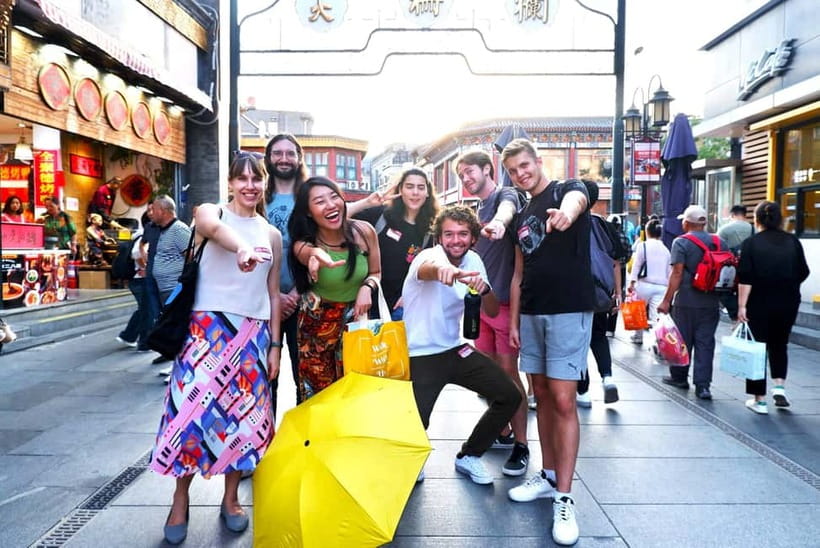
Look for the yellow umbrella. That is the useful landmark, especially because the station and surrounding streets can be confusing. The nearby Huguang Guild Opera Theatre is also listed as the taxi address and the first major stop.
Arrive five to ten minutes early. The station is described as massive, and heavy traffic can slow you down. The guide waits up to 20 minutes while giving the opening talk, but the group cannot hold the route for late arrivals.
The Huguang Guild Opera Theatre receives about 30 minutes of guided attention. This gives the tour a cultural start rather than sending you straight into a shopping street. The building connects to Beijing’s traditional performance culture, and it helps frame the city as more than imperial gates and government buildings.
The stop is guided rather than presented as a long independent visit. You should expect stories and orientation, not an extended theatre program.
Beijing hutongs and the special courtyard visit
From the theatre, the route moves into Beijing’s hutongs. These narrow lanes are among the best places to see how older residential Beijing was arranged. The streets are more intimate than the broad central avenues, and the guide can point out how homes, alleys, and neighborhood commerce fit together.
The first hutong section lasts around 30 minutes. That is enough time to get a feel for the area without turning the walk into a technical architecture lesson. The most useful part is the local perspective. The tour promises stories from people who have survived and adapted in these old neighborhoods, along with discussion of urban development challenges.
That context matters. Beijing’s older districts are not frozen history displays. They are places shaped by redevelopment, changing housing needs, commercial pressure, and the demands of a modern capital. A good guide helps you notice that tension without reducing the neighborhood to a collection of picturesque lanes.
The route includes a secret stop lasting about 20 minutes. The exact details are intentionally not given, but the main description identifies it as an authentic hutong courtyard visit. I would treat this as a short look inside a residential setting, not a full house tour or long cultural demonstration.
This is one of the strongest parts of the experience because it changes your view of the hutongs. From the street, you see walls, gates, doorways, and narrow passages. Inside a courtyard, you get a better sense of the shared layout that gives these neighborhoods their character.
The word authentic should not make you expect a preserved old home untouched by modern life. The tour also discusses urban change, so the value is seeing how an older form of city living fits into present-day Beijing.
Yangmeizhu Byway and Beijing’s old commercial life
Yangmeizhu Byway receives about 30 minutes of guided explanation. This section adds a different layer to the walk. Instead of focusing only on residential lanes, the route shows how old streets have developed into places for small shops, local businesses, and visitors.
The tour also includes a local antique shopping street. You can browse if you wish, but the point is not necessarily to buy. Street markets and old commercial areas are good places to observe the mix of local use and visitor interest.
I appreciate that the route does not treat shopping as the main event. You are walking through a district with a guide who can explain what makes the street worth seeing. That is more useful than being left in a shop with a sales pitch.
The route also passes Beijing’s narrowest hutong. The description does not give its name or exact width, so do not plan your day around a specific photo measurement. Expect a brief, visual stop that helps you understand how tightly packed some of these lanes can be.
More Walking Tours in Beijing
- Beijing Hutong Walking Food and Beer Tour at Hidden Restaurants
★ 5.0 · 1,132 reviews - Private Beijing Walking Tour of the Forbidden City with 7 Options
★ 5.0 · 675 reviews - Forbidden City Private Walking Tour with Optional Sights
★ 5.0 · 400 reviews - Beijing Private Hutong Food Walking Tour
★ 5.0 · 299 reviews
Calligraphy at the local studio
The calligraphy studio is the tour’s hands-on feature. You create your own Chinese calligraphy artwork and take it home. The activity is included, with no additional charge stated in the tour details.
This makes the outing more memorable than a standard sightseeing walk. You are not only looking at signs, gates, and old streets. You get a simple way to interact with a major part of Chinese cultural life and leave with something personal.
The information does not specify how long the studio activity lasts or what characters you will write. I would therefore expect a short introduction and guided attempt rather than a formal class in brush technique. That is fine for most visitors. The point is participation, not producing museum-quality calligraphy.
The activity may suit families, first-time visitors, and anyone who likes a practical souvenir. It also gives the group a natural pause after walking through the hutongs. Since this is a small-group activity, follow the guide’s instructions and allow the session to move at the group’s pace.
Daguanlou Cinema and the birthplace of Chinese cinema
The itinerary includes about 20 minutes at Daguanlou Cinema, described as the birthplace of Chinese cinema. This is a compact cultural stop, but it adds something different from the hutongs and market streets.
You will hear about the cinema’s place in China’s film story and see how entertainment history connects with the city around it. The stop is guided, so the experience depends heavily on the guide’s explanation. Carrie has been praised for discussing Beijing’s past, present, and future planning, which is exactly the kind of broad context that helps at a site like this.
Do not expect a long film screening or a full cinema museum visit. The schedule gives the stop 20 minutes. Think of it as a concise introduction and a chance to see a lesser-known part of central Beijing.
That short format is useful on a walking tour. You get several different subjects without spending the entire afternoon in one place.
Dashilan Residential District and snack break
The walk continues into Dashilan, also written as Dashilan Residential District. This area helps bridge old neighborhood life and the commercial center of Beijing. The route includes a local hutong street market, where you can stop for snacks and drinks.
Food is included as a snack break, not a full meal. The description promises some of the best local street food and drinks along the way, but it does not name the items or guarantee a particular dish. If you have dietary restrictions, ask the guide what is available before eating.
I like the practical value of this pause. Street food is easier to understand when someone explains what you are trying and how it fits into local daily life. It also gives you a chance to rest, talk with other people in the group, and compare notes about the neighborhoods you have just seen.
Dashilan can feel more commercial than the quieter hutong sections. That contrast is part of the route’s purpose. Beijing is not one single old quarter. Residential lanes, shopping streets, cultural buildings, and major public spaces overlap and compete for room.
The tour also promotes meeting fellow travelers. A shared snack and a calligraphy activity are better for conversation than a walk where everyone simply follows a flag.
Qianmen Street and Zhengyang Gate
Qianmen Street receives about 40 minutes, the longest scheduled stop on the route. It is one of central Beijing’s best-known pedestrian shopping areas, and the guide uses it to explain the city’s commercial and historical center.
You will also see Zhengyang Gate and its Arrow Tower. These structures help you picture the old walled city and the importance of its southern approach. The route begins near the old theatre and hutongs, then ends among major central landmarks, so the day has a clear geographic shape.
Qianmen Street is likely to feel more polished and visitor-oriented than the residential lanes. That may be a drawback if you want only quiet local streets. On the other hand, it gives you a useful contrast between preserved or presented heritage areas and lived-in neighborhoods.
The tour does not promise entry into every major building along the route. The sights are primarily experienced from the street, with guided explanations. That keeps the schedule moving and helps the group cover more ground, but you should not book this expecting an interior tour of Beijing’s major imperial monuments.
The outside view of Tiananmen Square
Tiananmen Square is included as an outside view. This is an important distinction. The tour provides orientation and a chance to see the area from outside, but it does not state that the group enters the square or visits nearby museums and monuments.
For a first visit, even an exterior view can help place Beijing’s central power district on the map. The guide also presents the city as China’s political center, linking the square to the wider story of Beijing’s transformation.
Security, access, and crowd conditions can change in this part of the city. The tour details do not promise a fixed viewing point or a specific amount of time here, so keep your expectations flexible.
What the guides add to the walk
The strongest praise goes to the guides. English is the tour language, and the guide’s storytelling is central to the experience. Chelsey called the guides incredible and praised the amount of information, while another booking described the tour as interesting and fully worthwhile.
Carrie is noted for explaining the past, present, and future planning of the hutongs. That is a valuable angle because it avoids presenting old Beijing as a decorative backdrop. Shery has been described as very kind and clear while explaining the route, even by someone who wanted a more exciting experience.
The difference between those two reactions is useful. This is an information-led walk with interactive stops, not an extreme or fast-paced activity. If you want a dramatic adventure, it may feel calm. If you want stories, context, and a manageable introduction to central Beijing, the pace should work well.
The advertised operation has led more than 2,400 tours since 2017 and welcomed more than 38,000 people. That suggests an established program, but the quality still rests on the individual guide assigned to your group.
Walking demands, timing, and preparation
The tour lasts 3.5 hours and moves between several central districts. The schedule includes roughly 30 minutes at the theatre, 30 minutes in the hutongs, 20 minutes at the special stop, 30 minutes on Yangmeizhu Byway, 20 minutes at Daguanlou Cinema, 30 minutes in Dashilan, and 40 minutes on Qianmen Street.
Those blocks add up to a structured outing with frequent stops. You should still expect a substantial amount of walking between them. Wear comfortable shoes and bring water, especially in warm weather. The supplied information does not state whether seating or restroom stops are available, so use facilities before the tour if possible.
China travel also requires practical planning. Google Maps is not reliable in China, so ignore the map pin and follow the written meeting instructions. Save the Chinese address for Huguang Guild Opera Theatre if you need to show it to a taxi driver.
The tour runs at set starting times, and availability depends on the date. Free cancellation is available up to 24 hours in advance, and you can reserve while paying later. Those terms are useful if your Beijing schedule may shift.
Who should book this experience?
I would choose this tour if you want a broad introduction to Beijing in one half-day. It suits first-time visitors, solo visitors hoping to meet people, couples, and families who prefer short cultural stops to a long indoor lecture.
It is especially good for anyone curious about hutongs as living neighborhoods rather than just old streets. The courtyard visit, snack break, and calligraphy activity give the route more substance than a simple landmark walk.
You may want something else if your priority is entering the Forbidden City, spending hours at Tiananmen Square, or visiting major museums. None of those are promised here. The experience is also not ideal if you dislike group pacing or want a private, highly customized route.
The $25 price is fair when you value an English guide, local snacks, the artwork, and the time saved finding the route yourself. Because one booking raised a concern about tip-based payment and platform pricing, confirm the current arrangement before committing.
Should you book the Old Beijing hutong walk?
Book it if you want the city explained through its streets, people, food, and changing neighborhoods. The best reasons are the local storytelling, the courtyard visit, and the calligraphy artwork you make yourself.
Skip it if you need a formal museum tour or guaranteed interior access to Beijing’s biggest sights. Arrive early at Hufangqiao, find the yellow umbrella, wear good walking shoes, and verify the payment setup. With those points clear, this is a practical and friendly way to spend a first afternoon in old Beijing.
FAQ
How long does the Beijing hutong walking tour last?
The tour lasts 3.5 hours.
What language is the tour conducted in?
The tour is conducted in English by a live English-speaking guide.
Where is the meeting point?
Meet at Hufangqiao Metro Station on Line 7, Exit D, the southwest exit. Walk about 60 meters east to the green space at the corner of Hufang Road and Luomashi Avenue, beside Huguang Guild Opera Theatre.
How will I find the tour group?
Look for the yellow umbrella at the green space near the meeting point.
Should I arrive early?
Yes. Arrive five to ten minutes early because the metro station is very large and traffic may delay you. The guide waits up to 20 minutes, but the tour cannot be delayed for late arrivals.
Is a calligraphy activity included?
Yes. You visit a local calligraphy studio, create Chinese calligraphy artwork, and take it home.
Are snacks included?
Yes. Snack breaks with local street food and drinks are included.
Does the tour visit Tiananmen Square?
The tour includes an outside view of Tiananmen Square. The provided details do not state that the group enters the square.
Can I cancel the booking?
You can cancel up to 24 hours in advance for a full refund. The tour also offers a reserve-now-and-pay-later option.
More Hutong Walks
- Temple Heaven, Summer Palace, Lama Temple, Hutong Bus Tour
★ 4.7 · 319 reviews - Temple of Heaven, Summer Palace, Lama Temple, Hutong Tours
★ 5.0 · 311 reviews - The Hutong Experience by Bike
★ 5.0 · 163 reviews - Beijing: Hutong Culinary Walking Tour with 15+ Tastings
★ 5.0 · 162 reviews
Newest reviews from Beijing
- Beijing: Explore the Forbidden City in Hanfu★ 5.0 · 4 reviews
- Beijing Tai Chi and Tea Ceremony Experience★ 5.0 · 4 reviews
- Jinshangling Great Wall Of Beijing Tickets And Other Option★ 4.0 · 4 reviews
- Private Full-Day Great Wall of China Hiking Tour from Jiankou to Mutianyu★ 4.5 · 4 reviews
- Tour the Great Wall with a Native from Downtown Beijing★ 4.8 · 4 reviews
- Beijing: Badaling Great Wall Private Tour w Language Option★ 4.3 · 4 reviews
- Beijing:Summer Palace & Tea or Calligraphy Experience Tour★ 4.6 · 4 reviews
- 7 Days Private Tour of Beijing, Xian, Shanghai by Bullet Train★ 5.0 · 4 reviews
Hutong Tours, compared.
Beijing Hutong Walking Food and Beer Tour at Hidden Restaurants
Read our review →
Temple Heaven, Summer Palace, Lama Temple, Hutong Bus Tour
Read our review →
Temple of Heaven, Summer Palace, Lama Temple, Hutong Tours
Read our review →

Beijing City Walk: Explore Hutongs Life and Old Beijing
Read our review →Browse the lists this tour appears in