
Reviewed · WALKING TOURS
Dark Side of Hong Kong – Kowloon Caged Homes Walking Tour
Hong Kong has a side most postcards skip. This two-hour walk through Prince Edward and Sham Shui Po examines the city’s housing crisis, income gap, and working-poor communities through streets, markets, rooftops, and a staged subdivided flat. I like the way the tour connects tiny homes to big economic forces, and I also like that guides such as Alice, Isaac, Grace, Summer, and Wind are praised for answering difficult questions clearly. The main drawback is simple: you do not enter an actual occupied cage home, so anyone expecting a direct visit to real private homes may find the experience limited.
This is not a cheerful sightseeing stroll. It can be uncomfortable and sad, but that is part of its value. At $32.82 per person, I see it as a fair price for a small-group lesson in modern Hong Kong, provided you want context rather than famous monuments, shopping, or entertainment.
In This Review
- Key points to know before you book
- Why this walk changes how you see Hong Kong
- Cedar Street and the 500-square-foot puzzle
- Ki Lung Street and the forces behind the crisis
- The staged subdivided flat on Cedar Street
- Lui Seng Chun and the human side of housing
- Yee Kuk Street and the city’s backstreets
- Hai Tan Street and the sharpest contrast
- Pei Ho Street and the rooftop view
- Kweilin Street and SoCo’s work
- What $32.82 buys you
- Who should take this tour?
- Should you book the Kowloon Caged Homes walk?
- FAQ
- Where does the tour start?
- What time does the tour begin?
- Where does the tour finish?
- How long does the experience last?
- How much does the tour cost?
- Is hotel pickup included?
- Will I visit an actual occupied cage home?
- What places are included on the route?
- Is the tour suitable for people with limited mobility?
- Can I cancel for a full refund?
Key points to know before you book
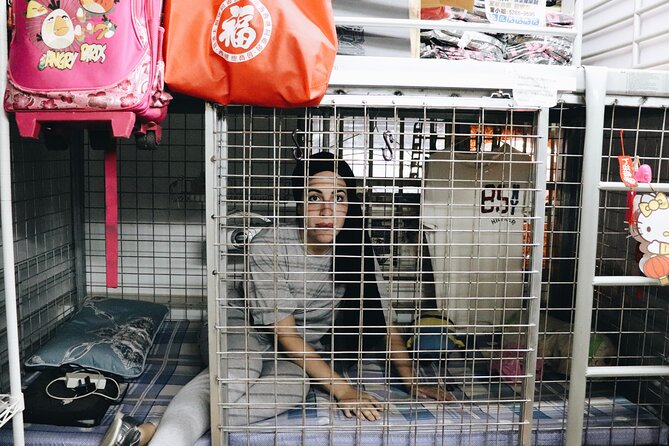
- A staged 100-square-foot flat shows the mechanics of subdivision: You see how a typical 500-square-foot apartment can be split into five units, each roughly 100 square feet.
- The walk links housing to economics and urban planning: Guides explain population growth, limited land, and Hong Kong’s low-tax capitalist model.
- Sham Shui Po supplies the setting: Traditional markets, backstreets, rooftop structures, and dense residential blocks make the subject visible around you.
- The tour ends with solutions, not only problems: A visit to SoCo introduces advocacy work for marginalized residents.
- Guide quality is a major strength: Alice, Isaac, Grace, Summer, Michael, Simeone Lo, and Wind have all been singled out for clear explanations and thoughtful answers.
- Expect a serious two hours: It is educational and sometimes heart-breaking, not a lighthearted city walk.
Why this walk changes how you see Hong Kong
Hong Kong is famous for soaring towers, polished shopping centers, and some of the world’s most expensive real estate. In Kowloon, that picture becomes harder to accept when you see how ordinary homes are divided into spaces barely large enough for a bed, kitchen corner, and personal belongings.
The tour begins at 11:00 a.m. on Nathan Road near Prince Edward. From there, you walk toward Sham Shui Po, one of the districts used to explain the city’s housing pressures. The route finishes near Sham Shui Po MTR Station, so you can continue exploring independently or catch the train without arranging a taxi.
I like the tour’s basic method. Instead of giving you a lecture in a classroom, it places the facts beside the buildings that make those facts real. A new apartment priced around $1.5 million can sit beside blocks containing subdivided units and cage homes. That physical contrast does more work than a brochure full of statistics.
The strongest guides keep the tone factual rather than theatrical. Alice is praised for her calm, clear approach. Isaac is especially good for people who enjoy economic and political background. Grace brings careful answers to basic and philosophical questions, while Summer has been praised for warmth and energy. Your guide will vary, but the repeated praise for the guiding team is one of the tour’s strongest selling points.
More Walking Tours in Hong Kong
- Introduction to Hong Kong: Central Tip Based Walking Tour
★ 5.0 · 202 reviews - Full-Day Private Customized Walking Tour of Hong Kong
★ 5.0 · 106 reviews - Hong Kong: Kowloon Street Market & Food Culture Walking Tour
★ 5.0 · 105 reviews
Cedar Street and the 500-square-foot puzzle
At Cedar Street, you begin with one of the tour’s clearest explanations: why Hong Kong is often ranked as the world’s least affordable city for housing. The guide uses a typical 500-square-foot apartment as a model, explaining how it can be divided into five units of about 100 square feet each.
That number matters because 500 square feet may already feel modest to many people. Once it is split among several households, each section has to contain the basic parts of daily life. Privacy, storage, cooking space, and room to move all become scarce.
The tour does not treat the issue as a personal failure. It explains how limited land supply, strong demand, population growth, and the city’s economic system helped create the pressure. This is useful because you leave with a clearer understanding of the system, not just an image of a cramped room.
You should also expect to pause on ordinary streets while the guide explains what you are seeing. This is not a grand attraction with signs and exhibits at every turn. Your attention needs to stay active.
Ki Lung Street and the forces behind the crisis
The stop on Ki Lung Street broadens the discussion. Post-war population growth is part of the story, but the guide also examines Hong Kong’s low-tax capitalist model and the shortage of buildable land.
That combination helps explain why housing prices can rise so sharply in a city where many people still work for modest wages. You also get a useful reminder that a housing crisis is rarely caused by one thing. Supply, policy, investment, population, and geography all push against one another.
If you enjoy economic subjects, this may be the most rewarding part of the walk. One strong point is the balance. The tour does not reduce Hong Kong to a cartoon of rich people and poor people. Instead, it gives you a framework for thinking about how the city functions and who gets squeezed by it.
The downside is that some of the time is spent listening rather than seeing. That is not a flaw if you want a walking seminar, but it can feel slow if you want constant activity.
The staged subdivided flat on Cedar Street
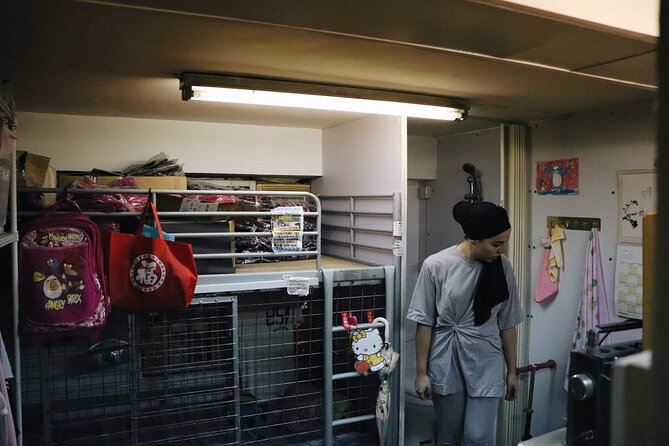
The return to Cedar Street brings the issue down to household scale. You enter a 100-square-foot subdivided display unit arranged to show how a kitchen, bed, and living area might fit into one tiny space for a minimum-wage family.
This is an important distinction: it is a staged display, not the occupied home of a family you are meeting. The tour also presents a cage home designed for one resident, but you should not expect to visit an actual occupied cage home.
Some people will find that disappointing. One person described the tour as short on physical content because the only subdivided flat was a display unit. That criticism is fair if you booked specifically to enter real homes.
Still, I think the display serves a practical purpose. It lets the guide explain the arrangement without intruding on someone’s private life. The tour’s stated aim is to understand grassroots living conditions and urban planning, not to put residents on show. That boundary matters.
You can decide for yourself how much weight to give the visual element. The display is useful, but the larger value remains the explanation around it.
A completely different kind of day out on the same trip:
- Hong Kong: Dolphin Cruise, Big Buddha & Lantau Island Tour
★ 4.2 · 1,512 reviews - Ngong Ping 360: Cable Car Return Tickets & Combos
★ 4.6 · 1,431 reviews - Lantau Island Day Trip – Big Buddha & Tai O
★ 4.5 · 1,328 reviews - Big Bus Hong Kong Open Top Hop-On Hop-Off Sightseeing Tour
★ 4.0 · 1,077 reviews
Lui Seng Chun and the human side of housing
At Lui Seng Chun, the guide shares firsthand experience of trying to find housing in one of the world’s toughest property markets. This stop adds a personal layer to the broader discussion.
Facts can tell you that housing is expensive. A guide’s own experience can show how those prices shape ordinary decisions, compromises, and family life. The best part of this stop is the chance to ask questions. The guides are repeatedly praised for responding carefully rather than rushing through a prepared script.
The tour works best when you participate. Ask about the terms you hear, the difference between public and private housing, or how low wages interact with high rent. The exact discussion will depend on your guide, but the format allows room for questions.
Yee Kuk Street and the city’s backstreets
Yee Kuk Street shifts the mood again. Here, the guide points out the less visible activity in Sham Shui Po’s backstreets and discusses links between the drug and sex trades.
This is sensitive material. It is not presented as entertainment, and you should not expect a staged crime show. The purpose is to show how poverty, insecure housing, and marginalization can overlap with other social problems.
Some people may find this section too grim, especially after the housing discussion. I see it as part of the tour’s attempt to present the district honestly, but the walk is not designed for a carefree morning.
The streets themselves also matter. You see a working neighborhood rather than a set of attractions polished for visitors. Be respectful with your camera and avoid treating people’s private lives as scenery.
Hai Tan Street and the sharpest contrast
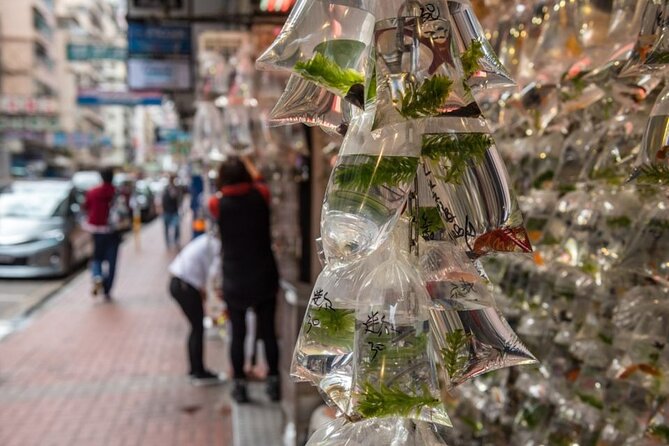
Hai Tan Street offers one of the route’s strongest visual moments. New apartments valued at about $1.5 million stand beside dense clusters of subdivided units and cage homes.
That is the kind of contrast you can understand in seconds. You do not need to imagine the income gap as an abstract chart. It is right in front of you, expressed through building size, maintenance, security, and available space.
The stop also helps explain why the word luxury can feel complicated in Hong Kong. A high-priced apartment may represent a major investment, while nearby residents may be working full time and still unable to afford a conventional home.
This is a good place to listen closely to the guide’s interpretation. The buildings alone do not explain every policy choice or household story. The value comes from placing the visible contrast within the wider housing discussion.
Pei Ho Street and the rooftop view
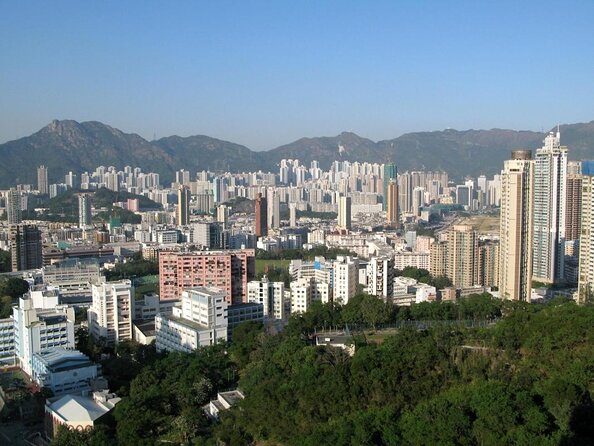
On Pei Ho Street, the group climbs to a rooftop in central Sham Shui Po. From above, you see rooftop structures and dense residential areas that are easy to miss from street level.
The rooftop stop gives the walk a different rhythm. After several street-level explanations, you gain a broader view of how tightly the district is packed. It also helps you notice the parts of Hong Kong that do not appear in tourism campaigns.
Physical effort is modest but real. The tour lasts about two hours and requires a moderate level of fitness. You will be walking through city streets and climbing to the rooftop, so wear comfortable shoes and be ready for Hong Kong’s heat. One person noted that most stops were indoors on a very hot day, which made the experience more manageable, but conditions can still affect your comfort.
For photographers, this section and the surrounding streets offer plenty to observe. Details in signs, rooftops, building fronts, and market life can tell small stories. Ask permission before photographing people or private spaces.
Kweilin Street and SoCo’s work
The final stop on Kweilin Street takes you to SoCo, a charity with 50 years of advocacy for marginalized people. This gives the tour a useful ending because it moves beyond describing hardship.
You discuss possible solutions and the city’s future. The conversation may not produce a neat answer, and it should not. Housing problems built over decades cannot be solved by one policy or one charity.
I appreciate that the route ends with civic action rather than leaving you with only shock. You see that residents and organizations are working to improve conditions, even when the problems are large.
The finish near Sham Shui Po MTR Station is practical. You can use the station for onward travel or remain in the district for food, markets, and independent walking. The tour guide may also point out places of interest. One person continued exploring afterward and tried snake soup based on a local recommendation, though that is not part of the tour.
What $32.82 buys you
At $32.82, the tour is not the cheapest way to spend two hours in Kowloon. You could walk through Sham Shui Po for free, visit markets independently, and observe the same general streets.
The difference is interpretation. Your fee pays for a local guide who connects the buildings, policies, and personal stories. If you simply want photographs, the price may feel high. If you want to understand why the neighborhood looks as it does, the cost is more reasonable.
The maximum group size is 30 people. That is large enough that you may not receive constant one-to-one attention, but the tour can still work well if the guide uses a clear speaking voice and the group stays together. The guiding team’s strong reputation helps justify the price, though guide quality can naturally vary from one departure to another.
Hotel pickup and drop-off are not included. You meet near Prince Edward at 11:00 a.m. and finish in Sham Shui Po. Public transport is nearby, and the mobile ticket makes entry simple.
Free cancellation is available up to 24 hours before the start time for a full refund. The experience requires good weather and a minimum number of people. If the operator cancels for weather or because too few people book, you are offered another date or a full refund.
Who should take this tour?
I would choose this walk if you want to understand Hong Kong beyond Victoria Harbour, luxury malls, and famous viewpoints. It suits people interested in housing, economics, social policy, photography, and modern city life.
Families with older children may also find it worthwhile. One person took a 16-year-old and found the visit difficult but valuable. The subject is serious, so you should prepare younger participants for poverty, overcrowding, and the drug and sex trades.
This tour may not suit you if you want a relaxed introduction to Hong Kong or a route filled with major monuments. It also may disappoint you if you expect to enter real occupied cage homes. The display unit is staged, and the tour observes the neighborhood without turning residents into an attraction.
The experience is offered in English, based on the praise for guides who speak clearly and answer questions in English. Service animals are allowed, and public transport is close by. You should still be prepared for walking, outdoor sections, and rooftop stairs.
Should you book the Kowloon Caged Homes walk?
Book it if you want a serious, fact-based look at Hong Kong’s housing crisis and income gap. The strongest parts are the guide explanations, the contrast between expensive new apartments and tiny subdivided units, the rooftop view, and the visit to SoCo.
Do not book it expecting a dramatic tour of occupied cage homes. You will see a staged display and the surrounding district, not private interiors in use. That limitation is ethically sensible, but it should be clear before you pay.
At $32.82, I think the tour is good value for curious visitors who want context. It is less convincing for anyone seeking constant sightseeing. If you approach it as a compact lesson in how Hong Kong works, you are likely to leave with a fuller, more honest picture of the city.
FAQ
Where does the tour start?
It starts at Nathan Road near Prince Edward in Hong Kong.
What time does the tour begin?
The scheduled start time is 11:00 a.m.
Where does the tour finish?
The walk ends in Sham Shui Po, near Sham Shui Po MTR Station.
How long does the experience last?
The tour lasts approximately two hours.
How much does the tour cost?
The listed price is $32.82 per person.
Is hotel pickup included?
No. Hotel pickup and drop-off are not included.
Will I visit an actual occupied cage home?
No. The tour includes a staged 100-square-foot subdivided flat and a display of a cage home. You do not visit an actual occupied cage home.
What places are included on the route?
The route includes Cedar Street, Ki Lung Street, Lui Seng Chun, Yee Kuk Street, Hai Tan Street, Pei Ho Street, and Kweilin Street, along with a visit to SoCo.
Is the tour suitable for people with limited mobility?
The activity requires a moderate level of physical fitness and includes walking and a rooftop visit. The supplied information does not give specific wheelchair-access details.
Can I cancel for a full refund?
Yes. You can cancel at least 24 hours before the start time for a full refund. Cancellations made less than 24 hours before the start time are not refunded.
Newest reviews from Hong Kong
- Lantau Peak Sunrise Climb★ 5.0 · 4 reviews
- Hong Kong MiniBus Transfer: Hotel / Cruise Terminal and Airport★ 4.5 · 4 reviews
- Hong Kong: Lantau Island & Tai O Cruise, Skip The Line Cable Car★ 3.5 · 4 reviews
- Private & Personalized Hong Kong Street Art Tour with a Local★ 5.0 · 4 reviews
- Classic Afternoon Tea Voyage in Hong Kong for 4 Pax★ 4.0 · 4 reviews
- 2025 Chinese New Year Fireworks Open Bar Yacht Dinner Cruise HK★ 4.5 · 4 reviews
- Hong Kong Heritage Walk★ 4.0 · 4 reviews
- Private Full Day Sightseeing Tour of Kowloon in Hong Kong★ 5.0 · 4 reviews
Walking Tours, compared.
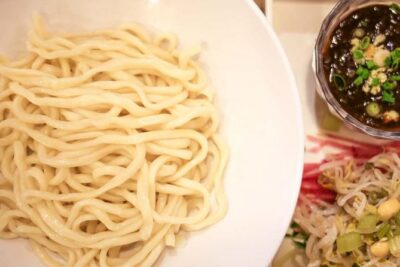
Beijing Hutong Walking Food and Beer Tour at Hidden Restaurants
Read our review →
Private Beijing Walking Tour of the Forbidden City with 7 Options
Read our review →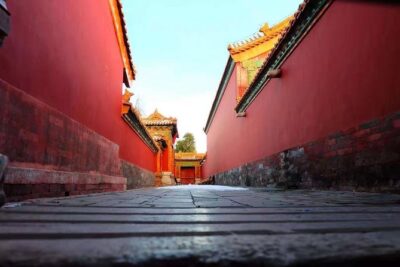
Forbidden City Private Walking Tour with Optional Sights
Read our review →
Shanghai City Guided Walking Tour | China’s 1st and Best Rated
Read our review →
Introduction to Hong Kong: Central Tip Based Walking Tour
Read our review →
Shanghai Highlights Walking Tour With A Real Local
Read our review →Browse the lists this tour appears in