
Reviewed · WORKSHOPS
Mahjong 101 Class for Beginners Workshop
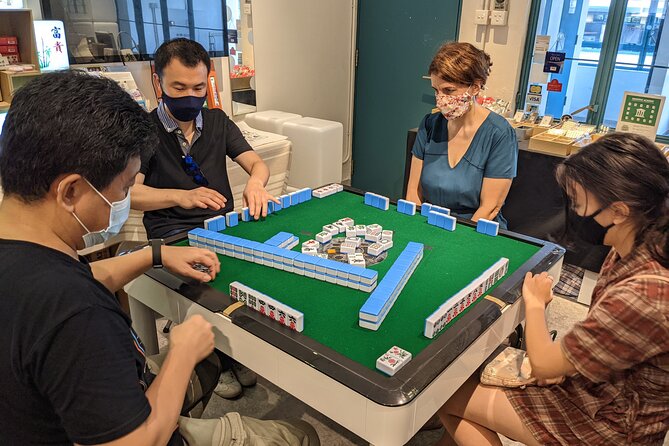
Mahjong starts with a wall of mysterious tiles. This two-hour class at Glocal Mahjong turns that wall into a playable game, with instruction on Cantonese Mahjong, tile recognition, winning patterns, basic scoring, etiquette, and strategy. The setting is PMQ, a restored historic site in Central that gives the lesson a strong Hong Kong cultural setting.
I like the small-group feel and the use of an electronic mahjong table, which should make the mechanics easier to follow for first-timers. I also like that the class covers more than rules. It connects the game to local traditions and explains why mahjong still matters today. The main consideration is the price: at $85.28 per person for about two hours, this is a focused cultural activity rather than a cheap casual pastime.
In This Review
- Key points at a glance
- Why PMQ is a smart setting for Mahjong
- What happens when you arrive at Glocal Mahjong
- Recognizing the tiles before making a move
- Learning how a Cantonese Mahjong game works
- Basic scoring and the logic of winning
- The electronic table and hands-on practice
- The museum side adds meaning to the lesson
- Is $85.28 a fair price?
- Who should book this two-hour class?
- Planning your visit around the class
- Should you book the Glocal Mahjong class?
- FAQ
- Where does the Mahjong class take place?
- How long does the class last?
- What type of Mahjong will I learn?
- What beginner skills are covered?
- Is the mahjong table provided?
- Is this a private activity?
- Where does the experience end?
- Can I cancel for a refund?
Key points at a glance
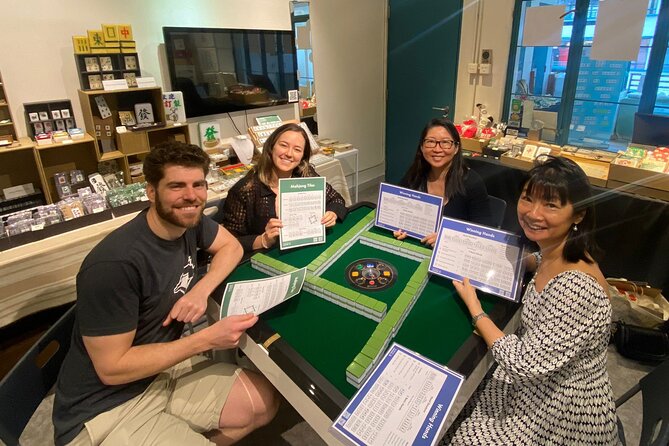
- Mahjong class inside a mini museum: Glocal Mahjong is both a teaching space and a shop displaying mahjong-related material.
- Cantonese Mahjong rules: You learn tile recognition, winning a game, basic scoring, and table etiquette.
- Electronic table included: The equipment is provided, giving beginners a practical way to follow the game.
- Private group format: Only your group participates, which can make questions and practice easier.
- Guide Marco adds historical context: His explanation of how the game started was singled out as a particularly strong part of the experience.
- Two hours in PMQ: The lesson fits neatly into a Central Hong Kong sightseeing day and ends where it begins.
Why PMQ is a smart setting for Mahjong
Glocal Mahjong is located at S405 on the fourth floor of PMQ, at 35 Aberdeen Street in Central. PMQ is not simply a place to pass through on the way to class. Its restored historic buildings and cultural shops give you a useful backdrop before you even sit at the table.
Mahjong is closely tied to Hong Kong social life, but its rules can look forbidding from the outside. PMQ helps frame the game as part of the city’s creative and cultural identity rather than as a private pastime you can understand only after years of practice.
The shop also functions as a mini mahjong museum. That matters because the class is not limited to button pressing and tile movements. You get a chance to see the game as an object of design and tradition, with older customs alongside newer ways of presenting mahjong to the public.
I would allow a little extra time around the class to look through PMQ. The lesson itself lasts about two hours, and the activity ends back at the meeting point, so you do not need to plan a complicated transfer afterward.
More workshops and classes in Hong Kong:
- Organic Chinese Dumpling Class with Market Walk
★ 5.0 · 88 reviews - Organic Xiao Long Bao Soup Dumpling Class & Market Walk
★ 5.0 · 62 reviews - Tea Tasting and Pairing Concept Workshop
★ 5.0 · 57 reviews
What happens when you arrive at Glocal Mahjong
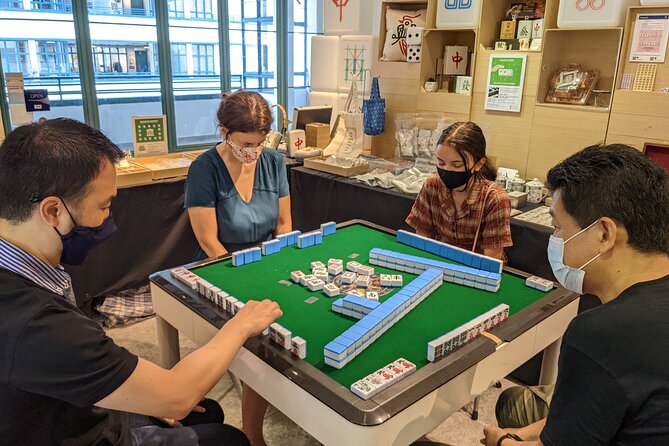
The meeting point is Glocal Mahjong, identified as 一筒 麻雀, at S405 on the fourth floor of PMQ. Since this is a private activity, your booking is limited to your own group rather than combined with unrelated participants.
That setup is useful for beginners. Mahjong has a lot of new vocabulary and visual information, so you may want to stop the instructor and ask about a tile, a move, or a scoring rule. In a large public class, you might hesitate. A private format gives your group more room to set the pace.
The description also refers to a small, cozy teaching environment. The exact number of people in a booking is not specified, so you should not assume a particular table size. Still, the private arrangement suggests a more personal lesson than a general demonstration.
The atmosphere should suit people who want a social activity but do not want to be thrown into a competitive game without guidance. You are there to learn first, then practice the ideas through play.
Recognizing the tiles before making a move
The first practical hurdle is learning to recognize the tiles. Mahjong is not a game where you can rely on one simple set of numbered cards. The tiles have different symbols and functions, and new players need time to understand what they are holding and what other players are doing.
This class specifically teaches tile recognition, making it a sensible choice for complete beginners. You do not need to arrive with a working knowledge of Mahjong. The goal is to give you the visual foundation needed to follow a hand.
The electronic table should help with this process. A table supplied by the operator means your group does not need to bring equipment, and the lesson can focus on the game itself. It also offers a practical setting for seeing how tiles are handled during play.
I would pay close attention here rather than rushing ahead to strategy. If you cannot identify the tiles quickly, later lessons on winning and scoring will feel much harder. The best use of the opening part of the class is to get comfortable with the pieces and their role in a hand.
Learning how a Cantonese Mahjong game works
The lesson focuses on Cantonese Mahjong, a traditional form that requires a mix of strategy, skill, and luck. That combination is part of the appeal. You are not simply following a fixed sequence, but you also cannot win through luck alone.
You learn how a game is won, which gives the class a clear practical target. Instead of leaving with only general cultural information, you should understand the basic conditions that bring a hand to an end.
The instructor also explains basic etiquette. This is an important part of learning any traditional table game. Rules tell you what you can do. Etiquette helps you understand how to behave while doing it.
For someone new to Mahjong, etiquette can be easy to overlook. A player may know which tile to draw but not understand the social rhythm of the table. Learning both at once gives you a better chance of joining a future game without feeling completely lost.
The class also addresses the social and competitive sides of Mahjong. That balance is helpful. If you see only the competition, the game may feel intimidating. If you see only the social side, you may miss the decisions that keep experienced players interested.
A few more tours worth putting side by side
- Hong Kong: Dolphin Cruise, Big Buddha & Lantau Island Tour
★ 4.2 · 1,512 reviews - Ngong Ping 360: Cable Car Return Tickets & Combos
★ 4.6 · 1,431 reviews - Lantau Island Day Trip – Big Buddha & Tai O
★ 4.5 · 1,328 reviews - Big Bus Hong Kong Open Top Hop-On Hop-Off Sightseeing Tour
★ 4.0 · 1,077 reviews
Basic scoring and the logic of winning
Scoring is often the point at which Mahjong becomes confusing. The class includes basic scoring rules, so you can begin to understand why one winning hand may be worth more than another.
You should not expect two hours to cover every possible scoring variation or advanced tactic. The experience is designed as a beginner workshop. Its value is in giving you a working base, not in turning you into a tournament player in one sitting.
That beginner focus is a strength for most visitors. You can learn the central ideas without spending an entire day on technical details. At the same time, the game retains enough complexity to reward further practice after the lesson.
The guide is also expected to explain different strategies used to win. Strategy in Mahjong is not just about collecting matching tiles. It includes recognizing useful combinations, watching what is happening at the table, and deciding when a move is worth the risk.
The available feedback gives Marco particular credit for being informative and for explaining how the game started. That historical background adds value to the scoring and strategy lesson because it places the rules inside a larger tradition. You are not simply memorizing a system. You are learning why the game has held people’s attention for so long.
The electronic table and hands-on practice
The electronic mahjong table is provided by Glocal Mahjong and forms a central part of the class. For a first lesson, this is practical. The table gives you a shared surface for learning and removes the need to arrange equipment yourself.
It also supports the social side of the class. Mahjong makes more sense when you can see a hand develop, watch the other players, and discuss a move as it happens. A lecture about tiles would be less useful than sitting around a table and applying the rules.
Because the lesson is private, your own group can practice without the pressure of playing against strangers. That can be especially helpful if your group includes people with very different levels of confidence.
There is a small limitation here. The information does not specify how many full hands you will play or how much time is given to each section. The exact balance between explanation and practice may depend on your group and the instructor. If hands-on play is your main reason for booking, you may want to ask Glocal Mahjong how the two hours are normally divided.
The museum side adds meaning to the lesson
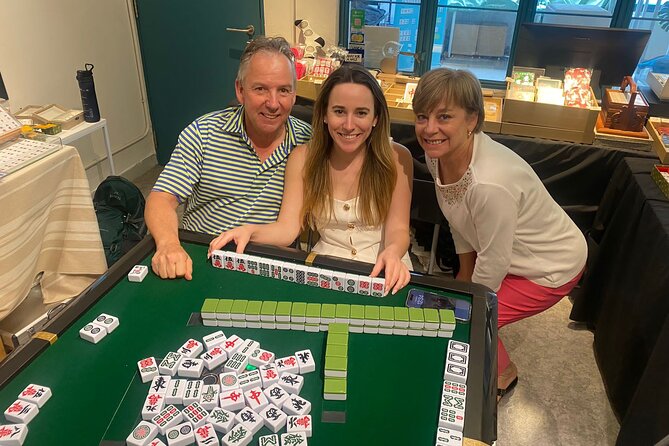
The mini museum element makes this more than a standard game lesson. Mahjong has a long history and remains part of social life in Hong Kong, so seeing related objects and learning about the game’s origins can change how you understand the activity.
This is where the class may appeal to people who do not usually choose game-based tours. You do not need to be a dedicated board-game fan. The cultural context gives the experience a wider purpose.
The class presents mahjong as both traditional and adaptable. That is a useful way to approach it in Hong Kong, where old customs and modern design often share the same space. Glocal Mahjong’s shop setting reflects that idea by presenting the game to beginners and experienced players alike.
The historical explanation from Marco is worth emphasizing. A clear account of how Mahjong started can make the lesson easier to remember, especially when the rules begin to blur together. Cultural background gives the tiles a story, not just a function.
Is $85.28 a fair price?
At $85.28 per person, this is not the least expensive way to spend two hours in Central. You are paying for instruction, a private group arrangement, the use of an electronic table, and the cultural setting at Glocal Mahjong.
The price makes more sense if you are booking for a small private group and want an organized introduction rather than trying to teach yourselves. It also compares differently from a museum visit. A museum can show you objects and explain a subject, while this class lets you practice the game under guidance.
I see the value most clearly for people who are curious about Hong Kong culture but need an activity with a clear structure. You receive a lesson in a traditional game, an explanation of its background, and an opportunity to take part rather than simply observe.
The value is weaker if you already play Cantonese Mahjong or want a long, advanced session. The advertised content centers on beginner fundamentals, and the duration is only about two hours. Experienced players may find the introduction too basic unless they are attending with friends who are new to the game.
Group discounts are available, which may improve the cost for families, friends, or private parties. Since the exact discount is not provided, check the price for your group before booking.
Who should book this two-hour class?
I would recommend it most strongly to:
- First-time Mahjong players who want a calm introduction
- Visitors interested in Hong Kong traditions and social customs
- Friends or families looking for a shared indoor activity
- People who enjoy learning through practice instead of watching a presentation
- Small private groups that want to ask questions freely
- Anyone curious about the history and modern role of Mahjong
The class may not suit you if you want a full-day cultural program, a tournament-style challenge, or advanced coaching. It is also not the right choice if your main goal is simply to see PMQ, since the central purpose is learning and playing Mahjong.
Most people can participate, and the activity is near public transportation. Confirmation is sent within 48 hours of booking, subject to availability, so give yourself time to receive that confirmation before arranging the rest of your day.
The experience is also listed as requiring good weather. If poor weather causes a cancellation, you are offered another date or a full refund. That condition is worth noting even though the class takes place indoors.
Planning your visit around the class
The activity begins and ends at Glocal Mahjong in PMQ. That makes the timing easy to manage. You do not need to coordinate a second meeting point or find transport across Hong Kong after the lesson.
The location in Central is useful for building a larger day around the class, but the information provided does not specify nearby attractions or a recommended route. Plan your transport based on the PMQ address and allow enough time to find S405 on the fourth floor.
I would avoid scheduling another fixed activity immediately afterward. A two-hour class can run at a relaxed teaching pace, and you may want a few minutes afterward to ask about rules you found confusing.
Free cancellation is available until 24 hours before the start time. Changes or cancellations made less than 24 hours before the activity are not accepted for a refund. Use Hong Kong local time when calculating the deadline.
Should you book the Glocal Mahjong class?
Book it if you want a personal, practical introduction to one of Hong Kong’s best-known traditional games. The private format, electronic table, and coverage of tiles, winning, etiquette, scoring, and strategy give beginners a solid starting point. Marco’s historical explanation is another reason to choose this class if cultural context matters to you.
Think twice if you are seeking a bargain or already know the basics. At $85.28, the cost is justified mainly by the private instruction and the chance to learn in a specialist mahjong setting. For the right group, it is a distinctive two-hour experience that gives you both a game to play and a better understanding of why it matters.
FAQ
Where does the Mahjong class take place?
The class takes place at Glocal Mahjong, 一筒 麻雀 S405, on the fourth floor of PMQ at 35 Aberdeen Street in Central, Hong Kong.
How long does the class last?
The activity lasts approximately two hours.
What type of Mahjong will I learn?
The class teaches Cantonese Mahjong.
What beginner skills are covered?
You learn how to recognize the tiles, how to win a game, basic etiquette, and basic scoring rules.
Is the mahjong table provided?
Yes. Glocal Mahjong provides an electronic mahjong table for the lesson.
Is this a private activity?
Yes. Only your group participates in the activity.
Where does the experience end?
The class ends back at the Glocal Mahjong meeting point in PMQ.
Can I cancel for a refund?
You can cancel up to 24 hours before the experience start time for a full refund. Cancellations or changes made less than 24 hours before the start time are not accepted for a refund.
Newest reviews from Hong Kong
- Lantau Peak Sunrise Climb★ 5.0 · 4 reviews
- Hong Kong MiniBus Transfer: Hotel / Cruise Terminal and Airport★ 4.5 · 4 reviews
- Hong Kong: Lantau Island & Tai O Cruise, Skip The Line Cable Car★ 3.5 · 4 reviews
- Private & Personalized Hong Kong Street Art Tour with a Local★ 5.0 · 4 reviews
- Classic Afternoon Tea Voyage in Hong Kong for 4 Pax★ 4.0 · 4 reviews
- 2025 Chinese New Year Fireworks Open Bar Yacht Dinner Cruise HK★ 4.5 · 4 reviews
- Hong Kong Heritage Walk★ 4.0 · 4 reviews
- Private Full Day Sightseeing Tour of Kowloon in Hong Kong★ 5.0 · 4 reviews
Workshops, compared.

Half-Day Chengdu Cooking Class with a Local Market Visit
Read our review →
Organic Chinese Dumpling Class with Market Walk
Read our review →

Online Cooking Class Beijing Dumplings and Cuisine by Sunflowerli Renowned Chef
Read our review →
Organic Xiao Long Bao Soup Dumpling Class & Market Walk
Read our review →
Beijing Wangfujing Calligraphy Class by Forbidden City
Read our review →Browse the lists this tour appears in