
Reviewed · WORKSHOPS
2-Hour Private Chinese Ink and Brush Painting Workshop in Shanghai
Paint Shanghai in black and white.
This private Chinese ink and brush class gives you a calm break from the city while introducing the old art of shui mo, or water and ink painting. I especially like the one-to-one attention from a professional artist and the fact that you take home a real painting, not just a souvenir trinket. Hotel pickup and a translator also make the class easy for first-time visitors. The main point to check is the workshop location, since the description refers to both the French Concession and Pudong.
The experience costs $118 per person and lasts about two hours, though the description also allows for a two-to-three-hour session. That price is fair for a private class with transportation and translation, but it is not a budget activity. I would choose it for a special cultural experience, a family outing, or a relaxed final day in Shanghai rather than for a quick stop between major sights.
In This Review
- Key points before you book
- Why this class feels different from a standard art activity
- Downtown pickup and the ride to the studio
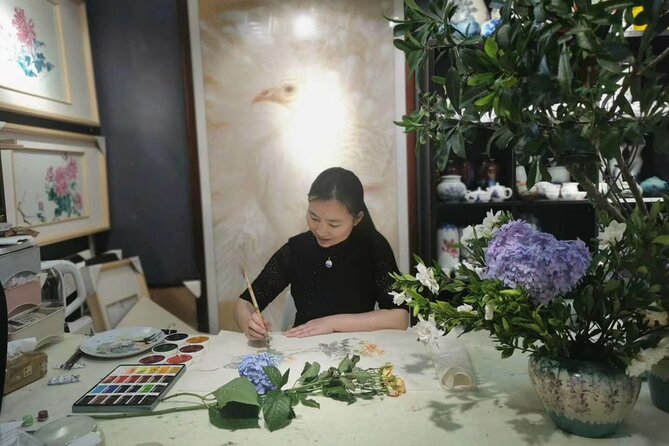
- Inside the private artist workshop
- Learning the four Chinese treasures
- From practice strokes to flowers and bamboo
- Tea and a slower afternoon in Shanghai
- What makes the private format worth $118
- A good choice for families and first-time painters
- Practical details that can affect your day
- The artwork you take home
- Who should book this Shanghai art class?
- Should you book the workshop?
- FAQ
- How long does the Chinese ink painting workshop last?
- Where does the workshop take place?
- Is hotel pickup included?
- Is hotel drop-off included?
- Is the class private?
- Do I need previous painting experience?
- Can children join the workshop?
Key points before you book
- Private instruction for your group: You are not placed in a large class, so the teacher can watch your brushwork and correct it as you go.
- Hotel pickup in downtown Shanghai: A local guide collects you from your downtown hotel and arranges a Didi ride to the studio.
- Tea, tools, and traditional technique: You learn about the four Chinese treasures of ink, brushes, paper, and ink stone while practicing on rice paper.
- A real artwork to take home: The goal is not only a demonstration. You create your own Chinese painting.
- Translator support matters: Guides such as Eric, Lucy, and Sunny have helped explain the teacher’s instructions in English.
- Choice of traditional subjects: Reviews specifically mention flowers, peonies, bamboo, and orchid as possible subjects.
Why this class feels different from a standard art activity
Many city tours give you a quick look at a craft, then move you along to the next stop. This class gives you time to sit down, handle the tools, and make mistakes without feeling rushed. That slower pace is the real attraction.
Chinese ink painting depends on pressure, water, speed, and restraint. A brush can create a thin line, a soft wash, or a dark, confident stroke depending on how you hold and move it. You are not simply filling in a printed design. You are learning how a small number of marks can suggest a flower, a branch, or a bamboo stalk.
The instructor begins with the materials and the basic ideas behind the art. You learn about the four traditional treasures: ink, brushes, paper, and the ink stone used to prepare the ink. These are not decorative props. Each affects the final mark, and the teacher shows you how to work with them.
I like that the activity does not require you to arrive with artistic talent. The class is built around basic brush strokes and simple subjects. You might still produce a crooked branch or a flower with an unusually dramatic personality, but the process is friendly and forgiving.
More workshops and classes in Shanghai:
- Private Cooking Class: Make Your Own Dim Sum In Shanghai
★ 5.0 · 27 reviews - Private Home Cooking Class with Shanghai Mama
★ 5.0 · 14 reviews - Unlock Chinese Tea: Culture, Science, Tasting & Hands-on Brewing
★ 5.0 · 12 reviews
Downtown pickup and the ride to the studio
Your local guide picks you up from a downtown Shanghai hotel. The included transfer is by local Didi, China’s widely used ride-hailing service, rather than by a dedicated tour bus. For you, that means a smaller and more personal start to the outing.
The guide handles the trip to the private artist workshop in Pudong. This is useful if you are not comfortable arranging a ride across Shanghai on your own, especially if you do not speak Chinese. The guide also remains important during the class because translation helps connect the artist’s demonstrations with your questions.
The location details need a little attention before booking. One part of the description refers to a workshop in the French Concession, while the detailed plan identifies Pudong New Area and a local community workshop there. Ask for the exact pickup and studio address after booking. Confirmation is sent within 48 hours, subject to availability, so this is a sensible question to settle early.
There is no hotel drop-off included. After the class, you will need to arrange your own return trip. Your guide can help with local transportation, but the return ride is not part of the stated inclusions.
Inside the private artist workshop
The workshop takes place in a local private artist studio. That setting gives the activity a more personal feel than a large commercial classroom. You are visiting an artist’s working environment and learning directly from a teacher who practices traditional Chinese art.
The class is private for your group. That matters most if you are traveling with children, a partner, or a friend who has never held a Chinese brush. The teacher can spend time showing you how to load the brush, control the water, and repeat a stroke until it feels natural.
Translation is provided by the local guide. Eric is specifically praised for getting a group to the artist’s residence and translating throughout the lesson. Lucy has also accompanied participants from their hotel and translated during a class with Ms. Chang. Sunny has been singled out for being friendly and patient, including when a hotel address needed correcting.
The guide is not just a person who points out the studio and leaves. Translation is central to the experience. Art instruction can be visual, but the finer points of composition, brush pressure, aesthetics, and symbolism are easier to understand when someone explains them clearly.
Learning the four Chinese treasures
The teacher introduces the basic tools before you begin painting. You learn about ink, brushes, paper, and the ink stone, often called the four treasures of the study in Chinese art.
The brush is the tool you will notice most. Its tip can produce a sharp line, while a heavier hand spreads the ink across the rice paper. Water changes the tone and softness of the mark. Paper absorbs the ink quickly, so you need to commit to each stroke rather than endlessly correcting it.
That can feel strange if you are used to sketching in pencil first. Chinese brush painting rewards confidence and economy. The class helps you understand that a simple line may carry more character than a crowded drawing.
You also get an introduction to the visual logic of traditional Chinese painting. The lesson may cover line quality, composition, and the balance of empty and painted space. One participant described the class as a way to reconnect with their inner self, but you do not need to approach it as a spiritual exercise. You can simply enjoy the focus required to guide ink across paper.
A few more tours worth putting side by side
- 2-Hour Chinese Calligraphy with an Artist in Shanghai, China
★ 5.0 · 46 reviews - Private 2-Hour Walking Tour of Shanghai’s Jewish Ghetto
★ 4.0 · 33 reviews - Private 2-Hour Shanghai Lanes and Alleyways Walking Tour
★ 4.5 · 14 reviews - 2-Hour “Ancient & Modern” Beijing Sidecar Tour (Day /Night)
★ 5.0 · 36 reviews
From practice strokes to flowers and bamboo
The lesson moves from basic exercises toward a finished subject. Reviews describe practice with the building blocks of linework before painting flowers. Peony, bamboo, and orchid are specifically mentioned as subject choices.
Flowers make a good first project because a few controlled strokes can suggest petals and leaves. Bamboo teaches a different rhythm, with attention to segmented stems and narrow leaves. Orchid gives you another kind of challenge, with delicate lines and a lighter touch.
The exact subject may depend on the teacher and the class. If you have a preference, ask at the start. That is particularly useful if one member of your group wants flowers while another would rather try bamboo.
The artist provides careful guidance as you work. You will likely watch a demonstration, repeat individual strokes, and then assemble them into a composition. The teacher’s patience is a recurring strength, especially for children and beginners.
Do not expect every painting to look like a master’s work. That is not a weakness of the class. The value is in learning how the image is built and leaving with something you made yourself. Your final paper may have uneven ink, but it will also have a story attached to it.
Tea and a slower afternoon in Shanghai
Tea is part of the experience, adding a quiet social element to the lesson. You can pause between exercises, watch the teacher work, and let the class settle into an easy rhythm.
This is a good choice after several days of Shanghai sightseeing. The city can be demanding, with long walks, traffic, crowds, and constant visual noise. Sitting at a worktable with tea and rice paper gives you a very different way to spend two hours.
The atmosphere is described as warm and friendly, and the teacher’s patient manner appears to be one of the strongest parts of the experience. That makes the class suitable for people who want cultural contact without a formal lecture or a packed schedule.
I would not book this if you want a fast, high-energy activity. The pleasure comes from slowing down. You need to pay attention to the brush, listen to the translation, and accept that the first few marks may not behave as planned.
What makes the private format worth $118
At $118 per person, this is a premium activity. The cost covers downtown hotel pickup, the Didi transfer to the studio, a private art lesson, a local guide, and translation. You also receive instruction from a professional artist and take home your own painting.
The value improves when two or more people in your party share the experience. You get private attention without joining strangers, and group discounts may be available. For a couple, family, or small group, the price can make more sense than paying separately for several short activities.
The class also saves you planning time. You do not need to locate a studio, arrange a cross-city ride, or work out how to explain your questions to an artist. The guide handles those practical details.
Still, the price is not mainly buying art materials. It is buying access, instruction, translation, transport, and a personal cultural activity. If your main goal is a cheap souvenir, you can find one elsewhere for much less. If you want to understand the tools and produce a painting under an artist’s direction, the price is easier to justify.
A good choice for families and first-time painters
Children must be accompanied by an adult, but the activity is open to most participants. The patient teaching style makes it a sensible family option, particularly if your children enjoy drawing or hands-on activities.
The private format is a major help with children. You can take breaks, ask for extra explanation, and avoid worrying about keeping pace with a large class. One parent-focused experience praised the teacher’s kindness and patience with kids.
Couples and friends can also enjoy the class without competing for the teacher’s attention. You can compare your brush strokes, encourage one another, and leave with two different versions of the same subject.
Solo visitors are welcome too. A local guide provides company and translation, and the studio setting gives you a more direct connection with the teacher. If you are alone, confirm the final per-person price and the exact class format before paying.
Practical details that can affect your day
The activity operates in all weather conditions, so dress appropriately. Since the class involves ink, practical clothing is a sensible choice. The workshop is near public transportation, although downtown pickup and the included Didi transfer reduce the need for you to navigate the route yourself.
Allow more than exactly two hours in your schedule. The stated duration is about two hours, while the description also says two to three hours. Add time for pickup, the trip to the studio, and arranging your return afterward.
This is a private activity, and only your group participates. Confirmation arrives within 48 hours of booking, subject to availability. Because the experience is non-refundable and cannot be changed after booking, confirm the date, number of participants, hotel address, and preferred painting subject before you commit.
The exact meeting arrangements deserve special care because the description gives different area references. The detailed plan names Pudong New Area, while another description mentions the French Concession. Treat that as a practical question, not a reason to reject the class. Ask Sunny Private Tours to confirm the workshop address and pickup time.
The artwork you take home
The finished painting is the clearest souvenir from the experience. You are not buying a mass-produced image from a shop. You are taking home a piece made during your own lesson, with all its slightly imperfect brushwork.
That personal mark is part of the charm. You will remember how much water was on the brush, how the ink spread across the paper, and how the teacher adjusted your grip. The picture may be simple, but it carries more meaning than something chosen from a shelf.
If you are flying soon after the class, ask how the painting will be protected for transport. The supplied information confirms that you take the artwork home, but it does not specify packaging or a tube. Bring a flat folder if you have one, or ask the guide what arrangement the studio uses.
Who should book this Shanghai art class?
Book it if you want a quieter cultural activity, direct instruction, and a souvenir you created yourself. It is especially well suited to couples, families with children, small groups, and people who enjoy crafts more than standard sightseeing.
I would also consider it for your last day in Shanghai. The class is relaxed, the pickup reduces planning, and the painting gives you a tangible reminder of the city after you leave.
This may not suit you if you want a broad museum tour, a history-heavy lesson, or a tightly timed activity with hotel drop-off. The class focuses on making art, not visiting several sights. You also need to arrange your own ride back to the hotel.
The perfect outcome is not a flawless painting. It is a better understanding of how Chinese ink painting works, plus a few quiet hours with tea, a patient teacher, and a brush that refuses to behave until you learn to guide it.
Should you book the workshop?
I would book this experience if the $118 price fits your budget and you want personal instruction rather than a quick demonstration. The strongest reasons are the private setting, the professional artist, the translator, and the finished painting you take home.
Before paying, confirm the Pudong or French Concession location, the pickup details, the expected duration, and whether your preferred subject is available. If those details suit your schedule, this is a thoughtful and unusually hands-on way to experience Shanghai.
FAQ
How long does the Chinese ink painting workshop last?
The experience lasts about two hours, although the description also allows for a two-to-three-hour class.
Where does the workshop take place?
The detailed itinerary identifies Pudong New Area and a local private artist workshop. Another part of the description mentions the French Concession, so confirm the exact studio address after booking.
Is hotel pickup included?
Yes. Pickup is offered from downtown Shanghai hotels, and a local guide arranges a Didi transfer to the art workshop.
Is hotel drop-off included?
No. Hotel drop-off is not included, so you need to arrange your own return after the class.
Is the class private?
Yes. Only your group participates in the activity, rather than joining a larger public class.
Do I need previous painting experience?
No previous experience is stated as a requirement. The class teaches basic brush strokes, materials, and traditional painting techniques, and most participants can take part.
Can children join the workshop?
Yes. Children can participate, but they must be accompanied by an adult. The teacher has been praised for being kind and patient with children.
Newest reviews from Shanghai
- Quick Tour to Xi’an Terracotta Warriors from Shanghai by Air in One Day★ 5.0 · 4 reviews
- Shanghai Zhujiajiao water town,Yugarden&Bund one day tour★ 5.0 · 4 reviews
- Wuzhen Private Full-Day Tour from Shanghai★ 5.0 · 4 reviews
- Private Round Trip Transfer to Zhouzhuang Water Village from Shanghai★ 5.0 · 4 reviews
- Full Day Private Tour Amazing Shanghai City Highlights★ 5.0 · 4 reviews
- Shanghai Tower Observation Deck 118 floor Tickets Pre-booking.★ 5.0 · 4 reviews
- Private Wet Market Visit with Cooking Class in Shanghai★ 3.0 · 4 reviews
- Zhujiajiao & Shanghai:Small Group Tour Water Town to Skyline★ 5.0 · 4 reviews
Workshops, compared.
Half-Day Chengdu Cooking Class with a Local Market Visit
Read our review →
Organic Chinese Dumpling Class with Market Walk
Read our review →
Online Cooking Class Beijing Dumplings and Cuisine by Sunflowerli Renowned Chef
Read our review →
Organic Xiao Long Bao Soup Dumpling Class & Market Walk
Read our review →
Beijing Wangfujing Calligraphy Class by Forbidden City
Read our review →Browse the lists this tour appears in