
Reviewed · HISTORICAL TOURS
UNESCO Watchtowers World Heritage Ancient Villages Private Tour
Step beyond Guangzhou’s city limits. This private Kaiping tour trades towers and old villages for farmland, fishponds, livestock sheds, and quiet country roads, making it a useful day out if you want to see a very different side of Guangdong. I like the private car and hotel pickup, which remove the fuss of arranging transport for a rural area, and I like the chance to visit several UNESCO-linked sites in one outing. The main drawback is the long road day, with Kaiping about two hours from Guangzhou and a total duration that can range from five to eleven hours.
I also like the flexibility for families and small groups, since only your party takes part and the itinerary can be followed up after booking. The $255 per-person price is not a bargain for a solo visitor, especially because admission fees and lunch are extra, but it can make better sense when shared by a group that values a private guide, air-conditioned vehicle, and door-to-door service.
In This Review
- Key points to know before you book
- Why Kaiping’s towers are worth the drive
- The long ride from Guangzhou
- Zili Village and its watchtower cluster
- Jinjiangli and the rural setting
- Li Garden’s East-meets-West design
- Majianglong’s five-village tower group
- Chikan Old Town and Cantonese qilou streets
- What the private format really adds
- Is $255 per person a fair price?
- Who should choose this Kaiping day trip?
- Should you book the UNESCO watchtower tour?
- FAQ
- How far is Kaiping from Guangzhou?
- Is hotel pickup included?
- Is this a private tour?
- Which places are visited?
- Are admission tickets included?
- Is lunch included?
- Can the tour help find an ancestor’s house?
- How far in advance is the tour usually booked?
Key points to know before you book
- Kaiping’s watchtowers were built by overseas Chinese families: These fortress-like homes reflect migration, money sent home, and the need for security in early twentieth-century rural Guangdong.
- Zili Village and Majianglong provide the main UNESCO interest: You see clusters of towers set among fields, waterways, and old village lanes rather than a single isolated monument.
- Li Garden adds a very different style: Its gardens combine Chinese design with Western touches and were built by Xie Weili, a Chinese resident of the United States.
- Chikan Old Town changes the mood: Expect Cantonese qilou buildings, older streets, and a town beside the Tan River rather than a purely rural village visit.
- The tour is genuinely private: Your group receives an English-speaking guide, a professional driver, and an air-conditioned car.
- Allow for extra costs and a long day: Entry tickets and lunch are not included, and the road journey from Guangzhou takes about two hours each way.
Why Kaiping’s towers are worth the drive
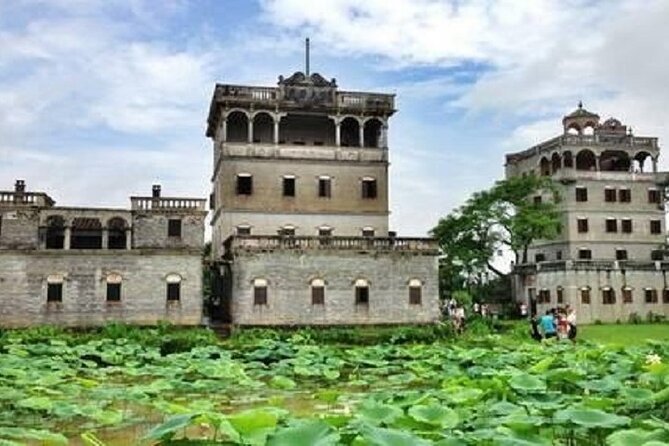
Kaiping’s diaolou, or watchtowers, are unusual rural buildings with a fortress-like appearance. Many were built in the early 1900s by overseas Chinese migrant workers or by families supported by relatives abroad. Their design tells you something important about the area: these were not simply decorative country houses. They were homes, lookout points, and places of safety.
I find the setting just as important as the architecture. The towers do not sit in a polished city district. They appear around village lanes, farmland, fishponds, rivers, and small agricultural buildings. That setting helps you understand how remarkable the structures must have looked to people living in a largely rural community.
The tour is especially useful if you have already seen Guangzhou’s major urban sights and want a contrast. Instead of high-rises and shopping streets, you spend the day among old homes, fields, waterways, and villages whose names can be hard to reach independently without a car.
More historical tours in Guangzhou:
- Private Historical Tour: Guangzhou City Sightseeing Including Lunch
★ 4.5 · 24 reviews - Guangzhou: Cantonese Heritage Tour with Key Cultural Stops
★ 5.0 · 13 reviews - All Inclusive Kaiping Diaolou Heritage Private Day Trip from Guangzhou
★ 5.0 · 5 reviews
The long ride from Guangzhou
Pickup and drop-off are provided at hotels in downtown Guangzhou. From there, you travel by private air-conditioned car with a professional driver and an English-speaking guide accompanying your group. Kaiping is around two hours from Guangzhou, so the drive is a meaningful part of the day rather than a quick transfer.
The total outing can last from five to eleven hours, depending on the final plan, traffic, and how much time you spend at each place. One eight-hour visit included the drive and offered a quieter weekday experience. That timing gives you a useful sense of the tour: it can fit into a full day without requiring an overnight stay, but you should not treat it as a short half-day excursion.
The private setup matters here. You are not working around a large coach schedule or waiting for strangers at each stop. You can discuss the order of sites with the provider after booking, and the company says it can also help arrange a visit to an ancestral home in Kaiping or Taishan if that is part of your family story.
That option is one of the most personal reasons to consider this service. Kaiping and Taishan are important hometown areas for many overseas Chinese families. If you are searching for an ancestor’s house, tell the operator early. A standard sightseeing day and an ancestry-focused visit may require different planning.
Zili Village and its watchtower cluster
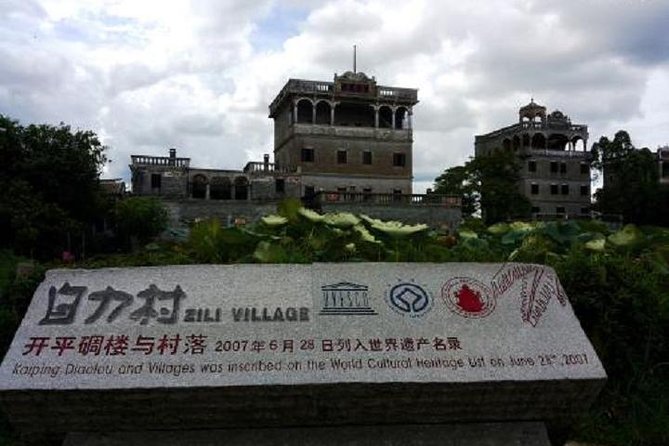
Zili Village is one of the central stops. The cluster was founded in 1837 during the Qing Dynasty and includes the villages of Anheli, He’anli, and Yong’anli. All three are associated with the Fang family.
The village is valuable because you see a group of towers and homes together, not just one impressive building. The cluster shows how these structures related to village life and to one another. You can look at the towers from rural paths and take in the contrast between heavy masonry, open farmland, and the low-rise homes around them.
The planned time here is about 90 minutes. That is enough for a focused visit, though the amount of time may feel brief if you enjoy architectural details or want many photographs. Admission is not included, so budget for the entrance fee before you arrive.
I would give Zili priority if your main reason for booking is UNESCO architecture. It offers the clearest look at the village clusters that make Kaiping special. Your guide can also add context about overseas Chinese families and the buildings’ purpose, which is more useful than simply walking around and photographing towers without understanding why they were built.
Jinjiangli and the rural setting
Jinjiangli Village offers a shorter stop of about 30 minutes. It is surrounded by hills, with paths crossing farmland and a river flowing nearby. Water buffaloes and geese may be part of the countryside scene, giving this visit a more ordinary, agricultural feel.
Do not expect another long museum stop here. The value is the setting and the quick change of pace. After examining the architecture at Zili, you get a glimpse of the village environment that supported these buildings.
Because the visit is short, your guide may need to keep the group moving. If rural scenery and everyday village details matter more to you than checking off another tower, ask how much time can be devoted to Jinjiangli when the itinerary is confirmed.
A few more tours worth putting side by side
- Guided Cycle Tour of Guangzhou
★ 5.0 · 164 reviews - Customised Private Guangzhou City Tour with Flexible Itinerary
★ 5.0 · 107 reviews - Gulong Gorge Skywalk Glass Bridge and Waterfall View Private Tour
★ 5.0 · 103 reviews - Private Guangzhou Full Day City Tour with Old and New Highlights
★ 5.0 · 62 reviews
Li Garden’s East-meets-West design
Li Garden, also called Kaiping Garden in the supplied schedule, was built in the early twentieth century by Xie Weili, a Chinese resident of the United States. Its plan draws on the Grand View Garden described in Dream of the Red Chamber and combines Chinese garden features with Western influences.
This stop breaks up the tower visits. The diaolou clusters feel defensive and practical, while Li Garden is designed around gardens, residences, and visual effect. The contrast helps explain that overseas Chinese influence did not produce just one type of building. Families brought back money, ideas, and tastes that changed the appearance of their hometowns.
The visit is planned for about one hour. Admission is extra, so you should treat the $255 price as covering transport and guiding rather than a fully packaged admission-inclusive day.
I would especially recommend Li Garden if you enjoy architecture and garden design, or if your group includes people who may find repeated tower visits too similar. It gives the day a different visual language and adds a more formal, planned setting.
Majianglong’s five-village tower group
Majianglong Village, also written as Ma-Xianglong in the schedule, lies on flat ground near the eastern side of the Tanjiang River. It includes five villages: Yong’an and Nan’an, associated with the Huang family, along with three others in the wider group.
The planned visit lasts about an hour. Like Zili, Majianglong is important because the towers form a wider village cluster. The rural setting, paths, and waterways help you see how the buildings fit into the community instead of treating each tower as a separate monument.
This stop also reinforces the family and migration story running through the whole tour. Kaiping’s architecture is not just an imported Western style placed in China. It grew from local families, overseas connections, money sent home, and the practical needs of village life.
The drawback is repetition. If your interest is only in seeing one famous tower, six stops may feel too full. If you want a broader understanding of Kaiping’s architecture and village patterns, Majianglong makes the day more worthwhile.
Chikan Old Town and Cantonese qilou streets
Chikan Old Town changes the setting once again. Built beside the Tan River and established in the early Qing Dynasty, it became an important town for nearby rural villages. It is known for Cantonese-style qilou, buildings with covered arcades along the street, along with Western-influenced buildings.
The schedule allows about two hours here, making it one of the longer stops. That gives you time to move beyond the isolated watchtower idea and see a traditional town with commercial streets and river connections.
I like this addition because it widens the tour’s scope. You are not simply visiting rural fortresses. You are also seeing how older Cantonese towns were built and how local trade and transport shaped their streets.
Still, the exact condition and atmosphere of an old town can vary. The experience is not presented as a polished theme park visit, and that is part of its appeal, but you should expect an older district rather than a perfectly restored attraction at every turn.
What the private format really adds
A private tour is most valuable here because the sites are spread across the Kaiping countryside. Your own car avoids the difficulty of piecing together several rural attractions by public transport, and hotel pickup saves you from reaching an unfamiliar departure point.
The English-speaking guide provides full escort rather than meeting you only at one attraction. That matters when the day includes several locations with similar-looking towers. A guide can help connect the Fang and Huang family villages, overseas Chinese migration, garden design, and the wider story of Kaiping.
The group size is limited to your party. That can be a major advantage for families, couples, and groups with a specific interest in ancestry or architecture. You can ask questions without competing with a large crowd, and you can discuss the order of stops after booking.
The tour provider is Guangzhou Local Tours. A provider response is signed Damon, so Damon may be your point of contact, though the supplied information does not confirm that he will personally guide every departure.
Is $255 per person a fair price?
At $255 per person, this is a premium day trip. You pay extra for a private car, professional driver, hotel pickup and drop-off, and a full-time English-speaking guide. You also avoid the time and uncertainty of planning a rural route on your own.
The value improves when several people share the private vehicle. For one person, the price is harder to justify because admission fees and lunch are not included. For a family or small group that wants comfort, flexibility, and direct transport from Guangzhou, the cost can be reasonable.
Plan for three separate expenses:
- The tour price of $255 per person
- Admission tickets at the attractions
- Lunch for you and the guide
The final cost depends partly on the route agreed after booking. Confirmation is sent within 48 hours, subject to availability. Since the booking is non-refundable and cannot be changed after purchase, confirm your date, hotel location, group size, and sightseeing priorities before paying.
Who should choose this Kaiping day trip?
I would choose this experience if you want rural Guangdong, historic architecture, and a private schedule in one day. It suits people who have a strong interest in Chinese diaspora history, family roots, village architecture, or old Cantonese towns.
It also works well for:
- Families who prefer a private vehicle
- Small groups splitting the cost
- Visitors staying in downtown Guangzhou
- People tracing ancestors from Kaiping or Taishan
- Architecture fans who want several related sites
- Anyone seeking a quieter weekday outing beyond the city
I would hesitate if you dislike long car rides or prefer a slow stay in one village. The tour covers a lot of ground, and admission fees and lunch require extra planning. It is also less suitable if you want a fully fixed, ticket-inclusive package with no decisions left to make.
The best tip is to state your priorities after booking. Ask for more time at Zili or Majianglong if towers are your main interest. Ask about the ancestral-home option if your family connection is the reason for visiting. If you mainly want a gentle countryside day, discuss how to keep the route comfortable rather than trying to force every stop into the schedule.
Should you book the UNESCO watchtower tour?
Book it if you want to see the real setting around Kaiping’s diaolou, not just one isolated landmark. The combination of Zili Village, Majianglong, Jinjiangli, Li Garden, and Chikan gives you architecture, family history, gardens, farmland, and an old town in one private outing.
Skip it if your budget is tight, you are traveling alone, or you want a short excursion. The road time is substantial, entry tickets and lunch are separate, and the day can stretch to eleven hours.
For most small groups with room in the budget, this is a strong way to reach Kaiping from Guangzhou. Its highest value comes from the private format and the chance to shape the day around your interests, especially an overseas Chinese family connection.
FAQ
How far is Kaiping from Guangzhou?
Kaiping is around two hours by car from Guangzhou. The full experience lasts approximately five to eleven hours, depending on the final schedule.
Is hotel pickup included?
Yes. Pickup and drop-off are provided at hotels in downtown Guangzhou.
Is this a private tour?
Yes. Only your group participates, with a private air-conditioned car, professional driver, and local English-speaking guide.
Which places are visited?
The planned stops include Kaiping’s diaolou and villages, Zili Village, Jinjiangli Village, Li Garden, Majianglong Village, and Chikan Old Town.
Are admission tickets included?
No. Admission fees are not included in the tour price.
Is lunch included?
No. Lunch for you and the guide is not included.
Can the tour help find an ancestor’s house?
The provider says it can assist with arranging an ancestral-home visit in Kaiping or Taishan. You should discuss this when the itinerary is confirmed after booking.
How far in advance is the tour usually booked?
It is booked an average of six days in advance. Confirmation is sent within 48 hours, subject to availability.
Newest reviews from Guangzhou
- Guangzhou VIP Car Tour– Tailored Sightseeing & Shopping Adventure★ 5.0 · 4 reviews
- Guangzhou Historical Day Tour By Metro & Boat★ 5.0 · 4 reviews
- Private Half-Day Guangzhou City Tour with Pickup★ 5.0 · 4 reviews
- Guangzhou Downtown Hotel – Baiyun Airport OneWay Private Transfer★ 5.0 · 4 reviews
- Private Guangzhou Night Tour with Canton Tower and Bar Hopping★ 5.0 · 4 reviews
- Guangzhou: Private Guided City Tour with a Local★ 4.7 · 4 reviews
- Private Guangzhou Night Tour VIP Cruise and Dim-Sum Dinner Option★ 5.0 · 4 reviews
- From Guangzhou: Mount Danxia and Nanhua Temple Full-Day★ 4.1 · 4 reviews
Historical Tours, compared.
Between Capitalism & Communism: Hong Kong History Tip Based Tour
Read our review →
Beijing Historical Tour II including Summer Palace, Lama Temple & Panda Garden
Read our review →
Beijing Historical Tour I – Forbidden City, Tiananmen Square & Temple of Heaven
Read our review →
Tour of Jewish Shanghai led by a Jewish History Expert
Read our review →
Beijing Historic City Guided Walking Tour + Calligraphy Creation
Read our review →
Beijing Culture: Tea Ceremony, Heritage Instrument & Calligraphy
Read our review →
All inclusive Two-Day Xi’an private Heritage Tour
Read our review →
2-Hour Beijing Private Forbidden City Tour: History & Highlights
Read our review →Browse the lists this tour appears in